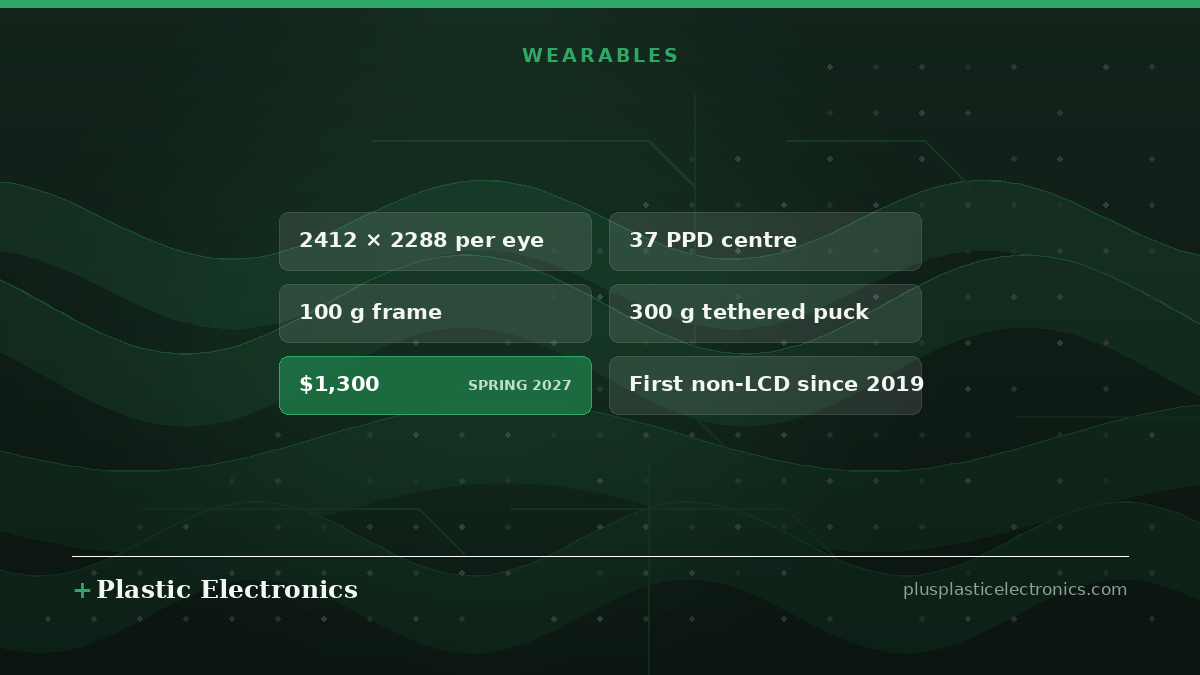
Meta announced a headset called VR Glasses at its Connect conference on 23 September, and the interesting thing about it is the display. The company has moved off LCD for the first time since the original Oculus Quest in 2019, putting two OLED-on-silicon microdisplays in a 100-gram frame and moving the computer into a puck on a cable.
The specification
Each eye gets a 2412 by 2288 micro-OLED panel running at 120Hz with HDR support. Meta quotes 37 pixels per degree at the centre of the field, against 25 for Quest 3, and the panel resolution is likewise up from Quest 3's 2064 by 2208. Reported field of view differs slightly between outlets: UploadVR gives 70 degrees horizontal by 66 vertical, about 87 degrees diagonal, while OLED-Info reports 70 by 60. Either way it is markedly narrower than Quest 3's 110 by 96 — the trade Meta has made for resolution and weight.
The frame is magnesium alloy, passively cooled with no fan, and uses an open-periphery design that leaves the wearer's vision to the side and below unobstructed. There is no onboard computing at all. A 300-gram tethered puck carries a Qualcomm Snapdragon Reality Elite, 12GB of RAM and 128GB of storage with a microSD slot, connected by what Meta describes as a thin, flexible hybrid fibre-optic cable that supplies both power and data. The puck runs the same operating system as Quest 3 and plays the same content, rendered higher thanks to the chipset and eye-tracked foveated rendering.
Sensing is more thorough than the display specification alone would suggest: a four-camera eye-tracking system, plus hand and face tracking. Touch Plus controllers are sold separately rather than bundled. Colour passthrough is quoted at 26 pixels per degree against Quest 3's 18. Meta also claims Dolby Vision HDR support and says the product is the first in VR to be IMAX Enhanced certified.
Price and timing
VR Glasses will cost $1,300 and ship in spring 2027, which is a long pre-announcement and leaves room for the specification to move. At that price it sits well above Quest 3 and well below where Apple's Vision Pro launched, in a segment that has so far not proved it exists in volume.
Why the display choice matters
Micro-OLED is what makes a 100-gram headset plausible. Emissive pixels on a silicon backplane are small and bright enough to allow compact optics, and the panel needs no backlight, so the weight saving compounds. The cost is that these are silicon devices, not plastic ones: the substrate is a wafer, the fab is a semiconductor fab, and the economics look nothing like the flexible OLED lines that supply phones. A headset shipping in the hundreds of thousands cannot amortise a fab the way a smartphone programme shipping hundreds of millions can, which is a large part of why micro-OLED headsets stay expensive.
It also puts the resolution problem in a specific place. Getting more pixels per degree means smaller emitting pixels on silicon, and the patterning methods that work at smartphone pitch do not obviously scale down — which is exactly the gap that this week's work on lithographically patterned OLED emitters is aimed at, though that research is years from a product.
For the wearables market the more immediate question is whether a tethered puck is accepted. Meta has traded the standalone independence that defined Quest for weight on the face, betting that 100 grams with a cable beats 500 grams without one. That is a different proposition from the unobtrusive all-day devices currently selling well, and the spring 2027 date means nobody will find out for eighteen months.