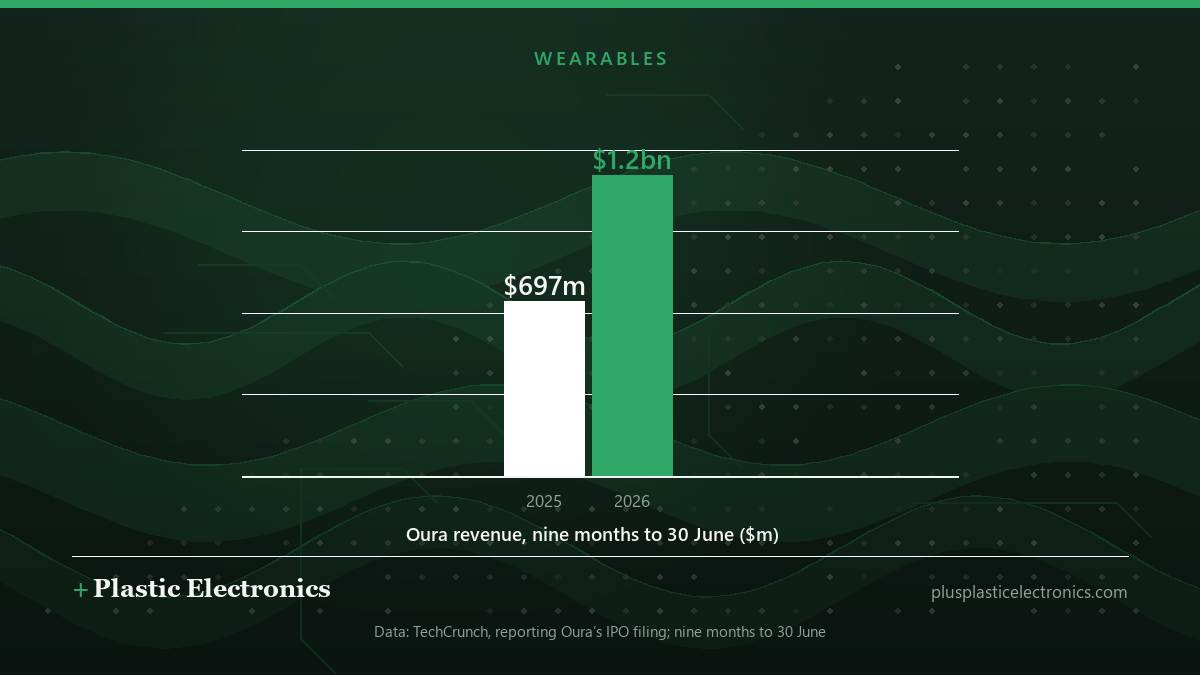
Oura, the maker of the Oura Ring, filed to go public with the US Securities and Exchange Commission on 3 September. According to TechCrunch’s report on the filing, Oura’s revenue for the nine months ended 30 June 2026 was $1.2 billion, up from $697 million a year earlier. The company sold 3.6 million rings over the past year and has about 5 million paying members.
A sensor business with a subscription
The numbers matter beyond Oura because the smart ring is one of the few new wearable form factors to reach real scale. TechCrunch reports that Oura’s rings retail for $350 to $400 and track 50 health and wellness metrics, including sleep, heart rate and stress. The company says it holds nearly 42 billion hours of physiological data for its AI and machine-learning models, and reports an 85% weighted-average 12-month retention rate among paying members.
TechCrunch cites Bloomberg as reporting that Oura expects to raise $3 billion at a valuation of $16 billion, up from about $11 billion in October 2025. We have read neither the Bloomberg report nor the filing itself.
TechCrunch also reports a risk that goes to the heart of optical sensing on the finger: a proposed class action alleging that Oura’s sleep tracking “relies on AI-generated estimates”, with users having complained about inaccurate readings. Oura disputes the claims.
The chasing pack
Rivals are repositioning around the listing. In a follow-up on 5 September, TechCrunch reported that Ultrahuman’s $479 Ring Pro was expected to begin shipping in the US in mid-September, with a redesigned heart-rate sensing system and a dual-core processor. Ultrahuman faced a US import ban in October 2025 after losing a patent dispute with Oura, and TechCrunch reports that it recently raised $70 million with backing from Qualcomm.
TechCrunch also lists RingConn’s Gen 3 at $349, launched in May, and Samsung’s Galaxy Ring at $399, launched in 2024. Circular’s Ring 3 series is due in early 2027 with NFC payments, vibration alerts and an FDA-cleared ECG on its Pro model. Dreame is a new entrant with haptic alerts and a touchpad.
Why it matters for sensor suppliers
A ring is an extreme packaging problem: optical emitters and detectors, temperature and motion sensing, a battery and a radio all curved into a narrow band. As a public company, Oura would have to report on the economics of that hardware in more detail than a private one. Much of its rivals’ differentiation, from redesigned heart-rate sensing to vibration motors and payment antennas, comes down to what can be fitted into the same curved space.
The accuracy lawsuit is the other signal. As rings move from wellness towards health claims, the category will increasingly be judged on validated sensor performance rather than on feature lists.
What we’re watching
- The pricing and timing of Oura’s listing, and what the final prospectus discloses about hardware margins.
- The outcome of the proposed class action over sleep-tracking accuracy.
- Independent accuracy comparisons between Oura and the Ring Pro once Ultrahuman’s ring ships.