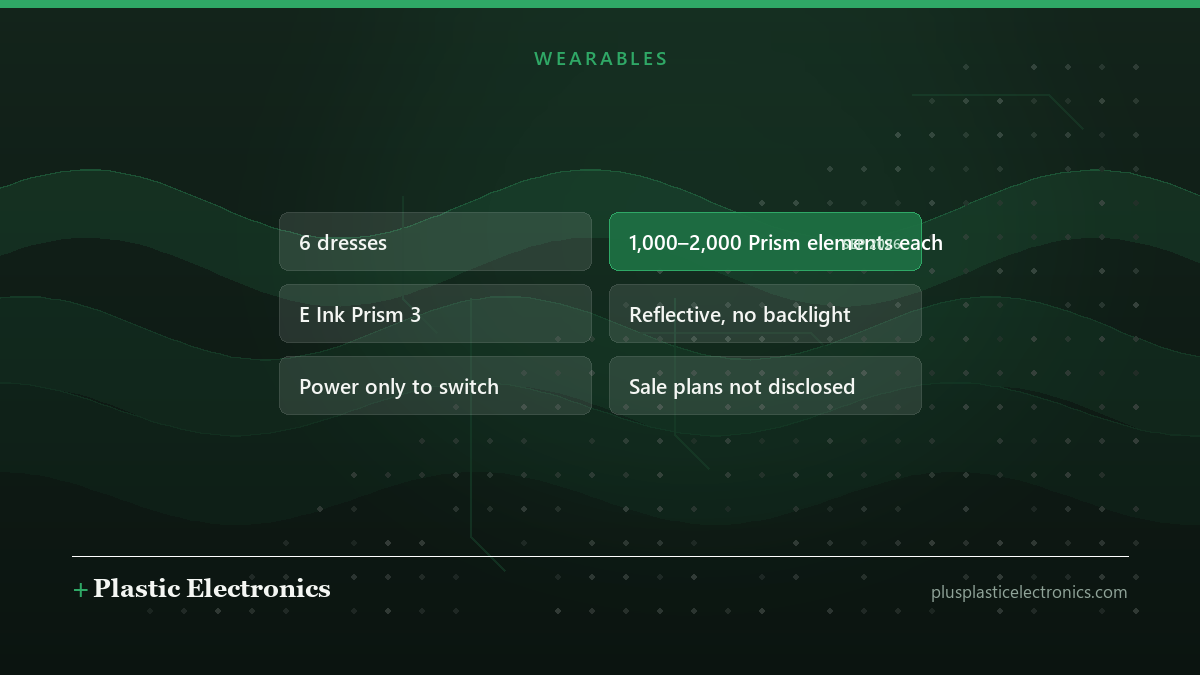
The Japanese fashion house ANREALAGE showed six colour-changing dresses at Paris Fashion Week on 29 September, each covered in between 1,000 and 2,000 individual pieces of E Ink Prism 3, the colour electrophoretic material E Ink sells for surfaces rather than screens. E Ink announced the collaboration the following day. The dresses were part of designer Kunihiko Morinaga's Spring/Summer 2027 collection, titled “SKIN”.
The Prism pieces are arranged like scales. Programmed in different arrangements, they let a single garment switch between colours and patterns, which E Ink describes as creating additional outfits out of one dress. A selection of the garments was then exhibited in Paris from 2 to 5 October.
Why e-paper suits a garment
Prism is reflective. Like an e-reader page, it uses ambient light rather than emitting its own, so the dresses change colour without glowing. It is also bistable: once a scale has switched, it holds its state with no power applied, and energy is consumed only during the change. For something worn on the body, that is the decisive property. A light-emitting display covering a dress would need continuous power and would get warm; a bistable surface that changes a few times during a show needs very little.
Breaking the surface into a thousand or more small tiles is also how the material copes with a body that bends. Prism is not stretchable, and a single large sheet would crease or crack on a moving figure. Small rigid elements on a flexible substrate is the same strategy the industry uses for stretchable circuits: keep the active parts small and let the gaps take the strain.
designboom, which covered the show, reports a dense network of wiring connecting the modules, with AI-assisted mapping used to organise the circuitry. The same collection included 3D-printed scales that shift colour with viewing angle and an LED-based camouflage finale, so e-paper was one of several surface technologies on the runway rather than the whole show.
What was not disclosed
The announcement is silent on almost everything that would tell an engineer how close this is to a wearable product. Neither E Ink nor ANREALAGE has said how the dresses are powered, where the battery and driver electronics sit, how the patterns are triggered, what each dress weighs, or how the elements tolerate washing, sweat and repeated flexing. No price, production run or sale plan has been announced. These are runway pieces, and the release presents them as such.
The resolution is coarse by display standards. Each scale is a single switchable area, so the garments show blocks and patterns of colour, not images. That is a deliberate trade: fewer, larger elements mean simpler wiring and fewer connections to fail.
Where E Ink is taking Prism
Naoki Sumita, president of E Ink Japan, said ANREALAGE has “a long history of combining craftsmanship, technology, and imagination in ways that challenge how we see everyday materials”. Taiwan News, reporting the collaboration, pointed to the other markets E Ink has been courting with the same material, from colour-changing vehicle exteriors and car interiors to fashion accessories.
The commercial core of E Ink remains reading devices and electronic shelf labels, and the company has been working on the cost side of its supply chain, including a stake in a copper conductive-ink developer. Projects like this one are about something else: establishing e-paper as a surface material that architects, car designers and fashion houses specify, rather than a screen. A runway is a cheap place to make that case. Whether any of it becomes clothing people can buy is a question the companies have not yet answered.