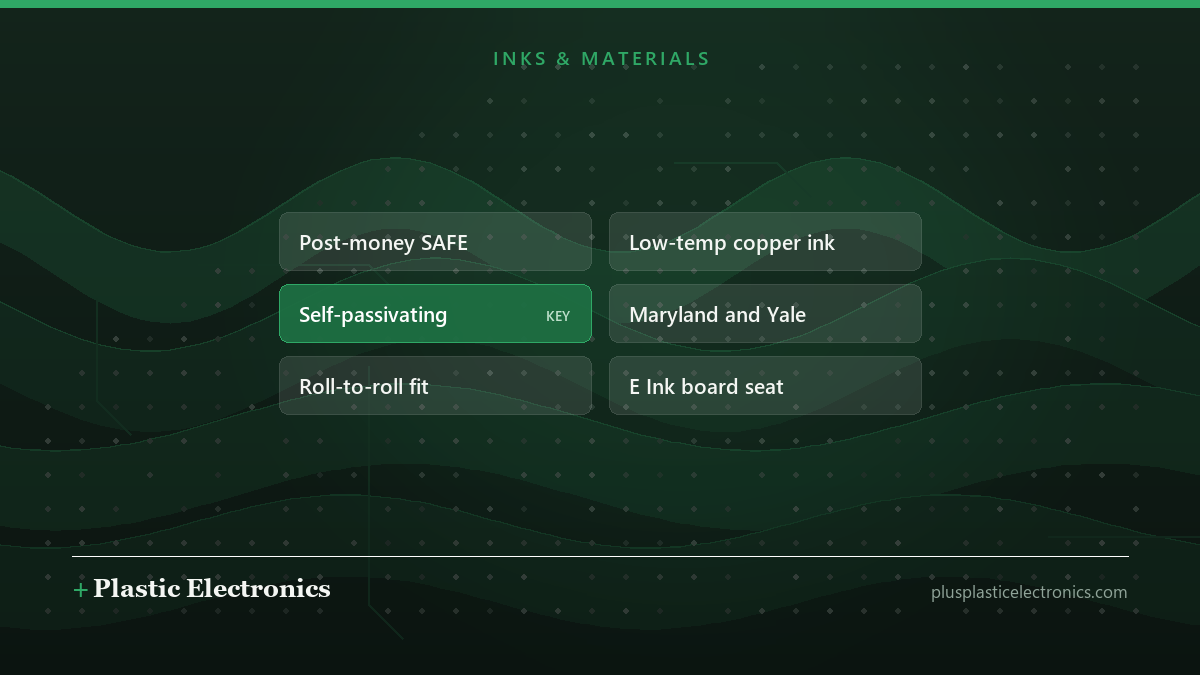
E Ink, the electrophoretic display maker, is investing in NewCopper, a privately held US start-up developing a conductive copper ink. The investment was announced on 10 September from Billerica, Massachusetts. It is an early-stage investment through a post-money Simple Agreement for Future Equity (SAFE), and the amount was not disclosed. E Ink chairman and chief executive Johnson Lee has joined NewCopper’s board as E Ink’s designated director.
The technology
NewCopper’s formulation comes from joint research by Professor Shenqiang Ren’s team at the University of Maryland and Professor Liangbing Hu at Yale University, and NewCopper holds an exclusive licence from the University of Maryland. E Ink describes it as a low-temperature, reactive, self-passivating copper ink designed to overcome copper’s long-standing weakness: oxidation.
That weakness is why silver still dominates. Copper conducts nearly as well as silver at far lower material cost, but copper particles and films oxidise in air, and the oxide raises resistance. Copper inks have therefore generally needed controlled curing or protective chemistry. A formulation that passivates itself would remove much of that process burden, if it performs as described. The announcement gives no curing temperatures, conductivity or stability data, and we have seen none.
Low-temperature processing matters as much as oxidation resistance. Printed electronics increasingly targets plastic films and paper that cannot survive the temperatures conventional metal sintering needs. A copper ink that cures at low temperature and protects itself from oxidation could run on roll-to-roll lines without an inert atmosphere. That would explain why E Ink stresses its compatibility with the company’s coating capabilities, although neither company has said so directly.
Why E Ink wants it
E Ink says the ink is compatible with its roll-to-roll coating capabilities, and that the collaboration will support production scale-up and evaluate copper ink for future display and electrode applications. It lists displays, sensors, solar technology, RFID, connected devices and flexible electronics as target markets. “By supporting NewCopper with resources, expertise and commercialization experience, we can also help guide the display industry to new heights,” Lee said.
Good e-Reader, reporting on 14 September, framed the deal as a way to reduce e-paper’s reliance on costly silver ink and to strengthen domestic supply chains for advanced electronic materials. For a company that coats film at scale for e-readers, shelf labels and signage, the cost of the conductor is a recurring line item rather than a one-off.
The context
The investment lands in a year when high silver prices have pushed many printed-electronics buyers to look again at alternatives. Our earlier silver conductive ink market update describes how pricing has fed through to ink suppliers.
What we’re watching
- Published conductivity, curing and ageing data for NewCopper’s ink.
- Whether E Ink qualifies copper conductors in a shipping e-paper product.
- The size of the investment, if either company discloses it.