Engineers at Georgia Tech, working with collaborators at MIT, have built a way for implanted devices to talk to each other and to a wearable hub without using radio at all. The system, reported in Science on 24 September, sends electrical pulses through the body's own tissue — and by removing the radio it removes most of the device.
Why not Bluetooth
Conventional short-range radio is a poor fit for something sitting inside a person. Bluetooth and NFC both struggle to push a signal through tissue, and paying that cost means an antenna, a power budget to drive it and, usually, careful alignment with a reader held against the skin. Those requirements set a floor on how small an implant can be, which in turn decides whether it needs surgery.
The Georgia Tech system, called SWANS — Smart Wireless Autonomous Networking System — uses the body as the medium instead. Tissue conducts ionically, and the team exploits that to carry electrical pulses between devices. Each implant is built to respond to a pulse of a particular voltage and duration, so a single shared channel can address one device without waking the others.
“They don't need to be connected, aligned or even near each other,” said Alex Abramson, an assistant professor in Georgia Tech's School of Chemical and Biomolecular Engineering and the paper's senior author, because “they can just send signals through the surrounding tissue.”
What removing the radio buys
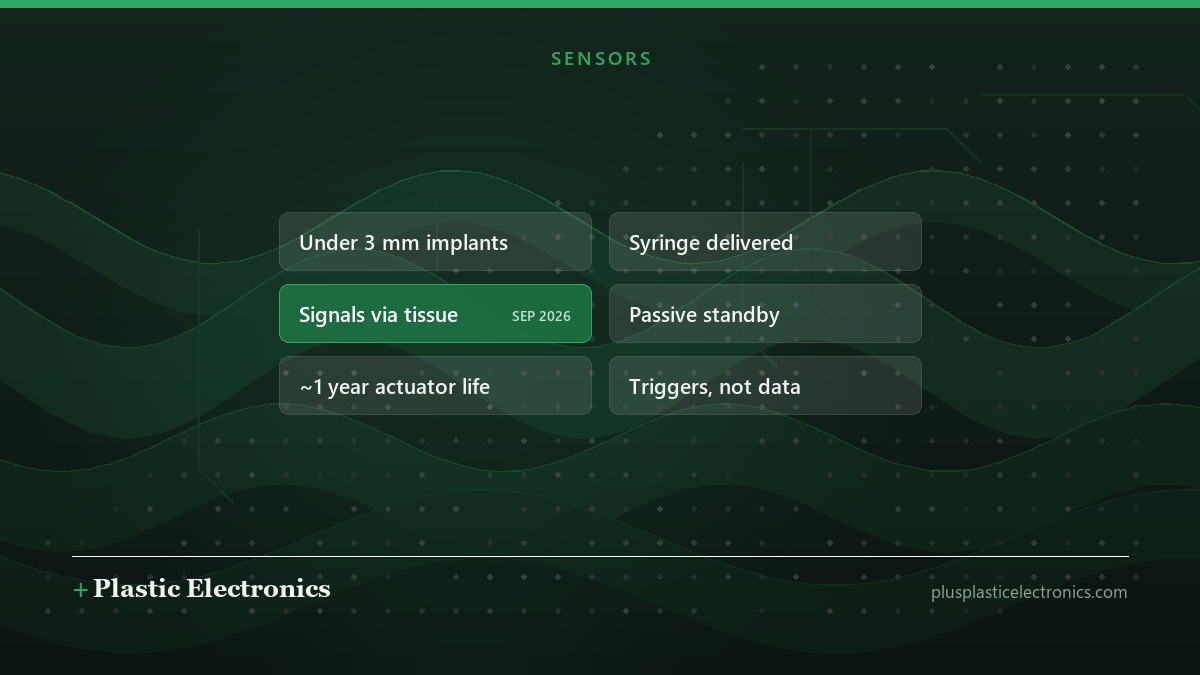
The components that wait for a pulse are passive, drawing essentially no power until they are triggered. That is what lets the implants come in under 3 millimetres, small enough to be delivered through a syringe rather than placed surgically, and it is why the team estimates that an actuator fired once a day should run for about a year before it needs replacing. Compared with other wireless approaches the researchers list a larger working area, no external antenna and looser alignment tolerances.
The demonstrations pair sensing in one place with action in another: a device can register a condition and trigger a second device elsewhere in the body to release a drug or stimulate a nerve. The reported experiments were in rats, including dual-limb motor control.
The limit worth noting
SWANS is a trigger channel, not a data link. It carries small yes/no instructions; anything larger goes through an external wearable hub. Therapeutic use in humans has not been studied, and the gap between a syringe-delivered actuator working in a rat and one approved for a patient is measured in years, not months — the same distance that separates most of the sensing patches this field keeps announcing from routine clinical use.
Still, the direction is the interesting part. Much of the effort in wearable and implantable electronics goes into making the power and communications subsystem smaller: it is why a textile vitals sleeve needed a grant just to engineer its wireless core, and why a cleared patch pump is still a two-piece device with a reusable half. Deleting the radio rather than shrinking it is a more radical answer than the usual one, and it is the kind of move that changes what a device can be rather than how well it performs.