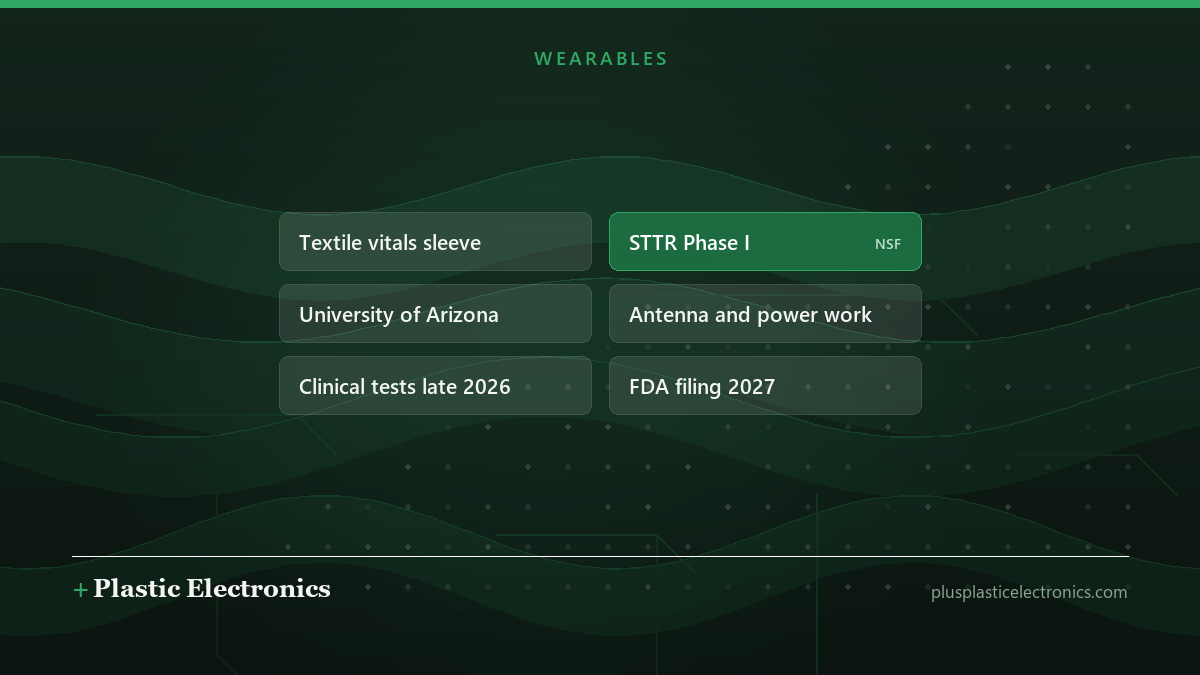
Senphonix, a medical technology start-up developing a wearable sleeve that monitors vital signs continuously, has received a Small Business Technology Transfer (STTR) Phase I award from the US National Science Foundation. The company announced the award, number 2537968, on 10 September. The work is carried out in partnership with the University of Arizona.
What SleeveSense is
SleeveSense is a wearable textile sleeve designed to stream multiple vital signs automatically over days, weeks or months, in hospital and at home. The company says the aim is to reduce manual nursing workload and detect patient deterioration earlier. Medical Device Network notes that the device is still a prototype.
A sleeve poses a different engineering problem from an adhesive chest patch. It can distribute sensors and electronics around the arm and avoid skin irritation from adhesives during long wear, but it has to keep sensors in consistent contact through movement and survive cleaning, long-standing challenges for textile electronics. The announcement does not say which vital signs SleeveSense measures, how the sensors are built into the fabric or how the sleeve is cleaned.
What the grant pays for
The company says the funding backs engineering on the wireless and radio-frequency systems, including antenna and power systems, and on advancing the prototype towards scalable manufacturing. Medical Device Network reports that the work also covers optimising performance under hospital conditions. Earlier grants from the Arizona Commerce Authority, through the WearTech Applied Research Center, supported prototype development.
Dr Philipp Gutruf, an associate professor at the University of Arizona, leads the academic side of the partnership. “Continuous, comfortable, long-term monitoring can change how patient vitals are tracked both in the hospital and at home,” said Mike Haldane, co-founder and co-chief executive.
Wireless power and radio design are a sensible first priority for a garment-style monitor. A device meant to be worn for days or weeks cannot depend on frequent cable charging, and antennas placed in fabric sit close to the body. Tissue absorbs radio energy and changes an antenna’s behaviour as the wearer moves, so a sleeve that works on the bench can lose its link on a patient. Solving that before clinical testing is cheaper than discovering it during a study.
Timeline
Senphonix expects clinical testing to begin in late 2026 or early 2027 and plans to pursue FDA clearance in early to mid-2027, with a market launch targeted for 2027. STTR Phase I awards fund feasibility-stage work, and the announcement does not give the value of this one. For the circuit side of conformable wearables, see our coverage of stretchable circuits.
What we’re watching
- Which vital signs SleeveSense measures, and against what clinical reference.
- Wear and cleaning durability data for the textile platform.
- The start of clinical testing, and any follow-on Phase II funding.