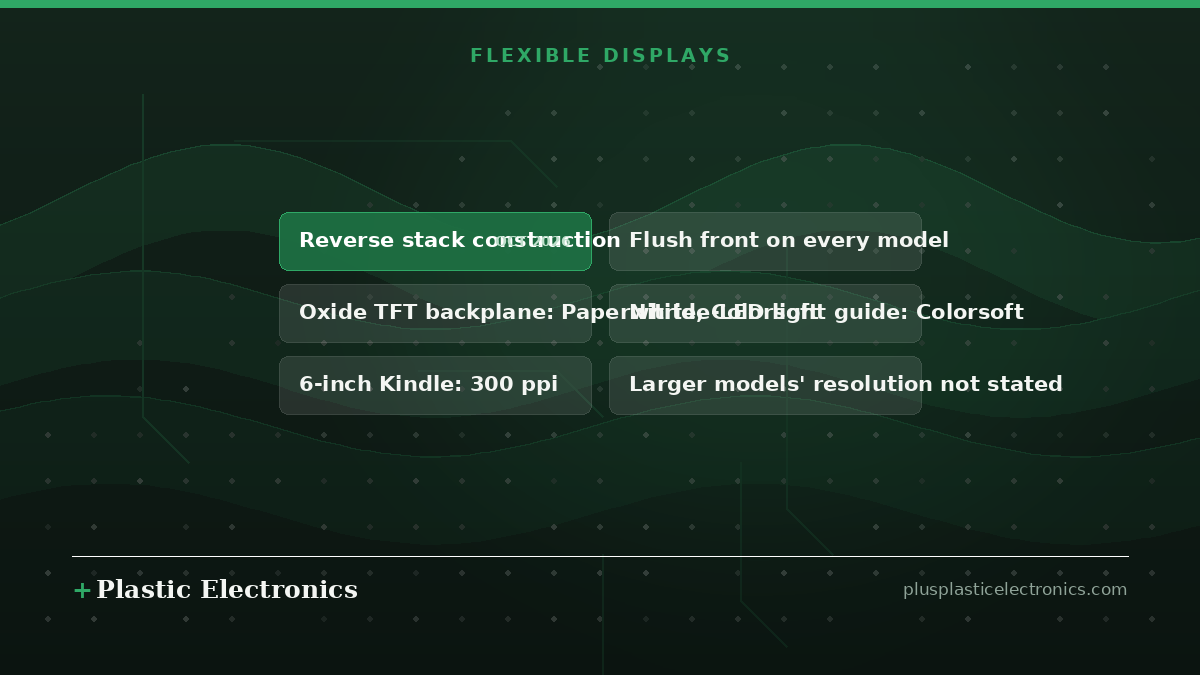
Amazon announced a redesigned Kindle range on 1 October: a 6-inch Kindle, a 7-inch Kindle Paperwhite and a 7-inch Kindle Colorsoft, each in standard and higher-specified versions. The common change is in the display. Amazon says every model uses a "newly designed reverse stack display construction", which it calls "a first for the e-reader category", so that the screen sits flush with the front of the device with no raised border around it.
The 6-inch Kindle went on sale immediately at $149.99 with 16GB, or $189.99 for a 32GB version with an aluminium back. The Paperwhite costs $199.99, or $249.99 as a Signature Edition, and the Colorsoft $289.99 or $319.99. The eBook Reader reports that the Paperwhite and Colorsoft are on pre-order for release on 28 October.
What changed in the stack
An e-reader display is a sandwich: a thin-film transistor backplane, the e-paper film, then a front light guide, touch sensor and cover. Flat glass fronts are not new on premium e-readers, but on cheaper models the screen has typically sat below a raised bezel. Amazon has not explained what is reversed in its new construction, or which layers moved, and the company's announcement gives no cross-section.
It is more specific about the other components. The Paperwhite moves to an oxide thin-film transistor backplane, and Amazon claims it has the highest contrast of any Kindle. The Colorsoft display is described as "completely redesigned": a light guide with nitride LEDs to raise brightness and improve colour, micro-deflectors that reduce stray light and improve uniformity, an ultra-thin optical coating, an oxide backplane driven with custom waveforms for faster updates, and "reverse printing technology" to carry colour to the edge of the screen.
The front light is the right place to work on a colour e-paper reader. Colour e-paper filters the reflected light, so the page is dimmer and less saturated than a monochrome one, and a front light that scatters unevenly makes that worse. The same trade-off between colour and reflectivity shapes larger e-paper uses, from shelf labels to the colour-changing garments shown in Paris last month.
What Amazon did not say
Resolution is stated only for the smallest model: E-Ink-Info lists the 6-inch Kindle at 300 pixels per inch. Amazon gives no pixel density for the Paperwhite or Colorsoft, no colour resolution for the Colorsoft, no contrast figure behind the "highest contrast" claim, and does not name the generation of E Ink film used. Nor does it give thicknesses or weights, beyond saying every model is thinner and lighter than before.
One detail the announcement left out appears on Amazon's own support pages. The eBook Reader found that the "Identify Your Kindle" page describes the new devices as having a "User-replaceable battery (EBR-compliant)", apparently a reference to the EU batteries regulation. Battery life is quoted at up to six weeks for the Kindle, according to E-Ink-Info, and up to 12 weeks for the Paperwhite.
For the e-paper supply chain, a new stack design across a whole range implies new lamination, front-light and cover parts, though Amazon names none of its suppliers. Its description is precise about the optics and silent on the panel itself.