Engineers at MIT have built a soft silicone sheet that reconstructs its own three-dimensional shape as it bends and twists, using light travelling through rubber optical fibres embedded in it. The work, by graduate students Qifan Yu and Nina Cao and assistant professor of mechanical engineering Kaitlyn Becker, was announced by MIT on 8 October and is published in Advanced Intelligent Systems. The group sees it as a wearable motion-sensing skin for physical therapy, virtual reality, gaming and the remote control of robots.
How light becomes shape
Many soft shape and strain sensors measure resistance or capacitance in a printed or moulded conductor, as with the printable pressure sensors now used on soft robots. The MIT sheet works optically instead. The team made its own fibres from a flexible rubber core inside black rubber cladding, and ran several of them in a zigzag through the silicone. An LED at one end of each fibre sends light in; a light sensor at the other end measures what arrives. When the fibre bends, some light escapes.
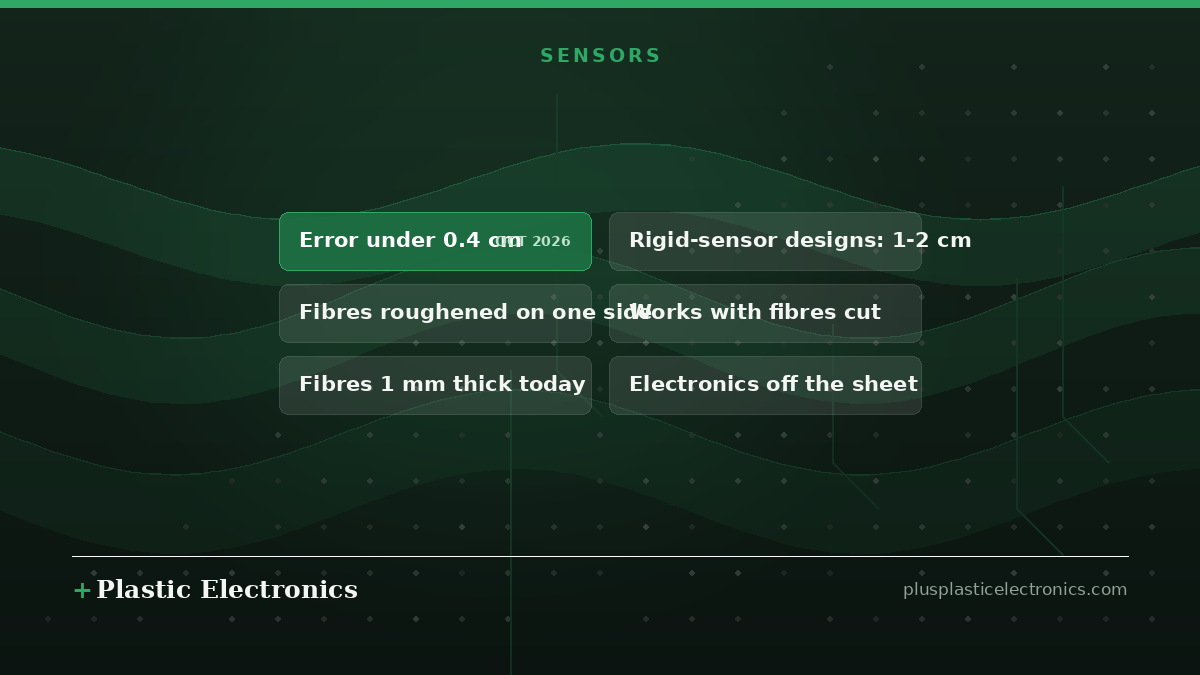
The useful trick is asymmetry. A smooth fibre loses roughly the same light whichever way it bends, so it can report how much it is curved but not in which direction. The researchers deliberately roughened one side of each core. Bending towards the rough side scatters more light than bending towards the smooth side, so each fibre's signal encodes direction as well as degree. An algorithm combines the readings from all the fibres into a digital reconstruction of the surface in near real time.
How good it is
To check the reconstructions, the team pressed the sheet into 3D-printed moulds of known shape and compared. "We found our error was less than 0.4 centimeters," one of the researchers told MIT News, measuring the distance between the actual and reconstructed surfaces. TechXplore's account of the release compares that with errors of 1 to 2cm for existing designs that use rigid sensors. The sheet also continued to estimate its shape when some fibres were cut or disconnected, which matters for anything worn and flexed repeatedly.
The researchers frame the clinical use plainly: the sheets "could help a physical therapist to recall and compare more precisely how an evaluation went today versus two months ago", as MIT News quotes it.
The trade-offs
The fibres are currently about 1mm thick. The team wants to bring them down to tens of micrometres so that more of them can be packed into a garment and finer movements captured; until then, resolution is limited by how few fibres fit. The LEDs and light sensors are connected to separate circuit boards that collect and amplify the signals, so the sheet is not yet a self-contained wearable, and power, wireless links and laundering are not discussed.
None of the reports gives the size of the test sheet, the number of fibres, the update rate behind "near real time", or how the signals drift over thousands of bending cycles. The comparison with rigid sensors is the group's own framing. Optical sensing avoids the contact resistance and cracking that trouble stretchable conductive circuits, but it moves the problem to the optoelectronics at each fibre end, which for a garment would have to become as soft and small as the fibres. The work was partly funded by MathWorks.