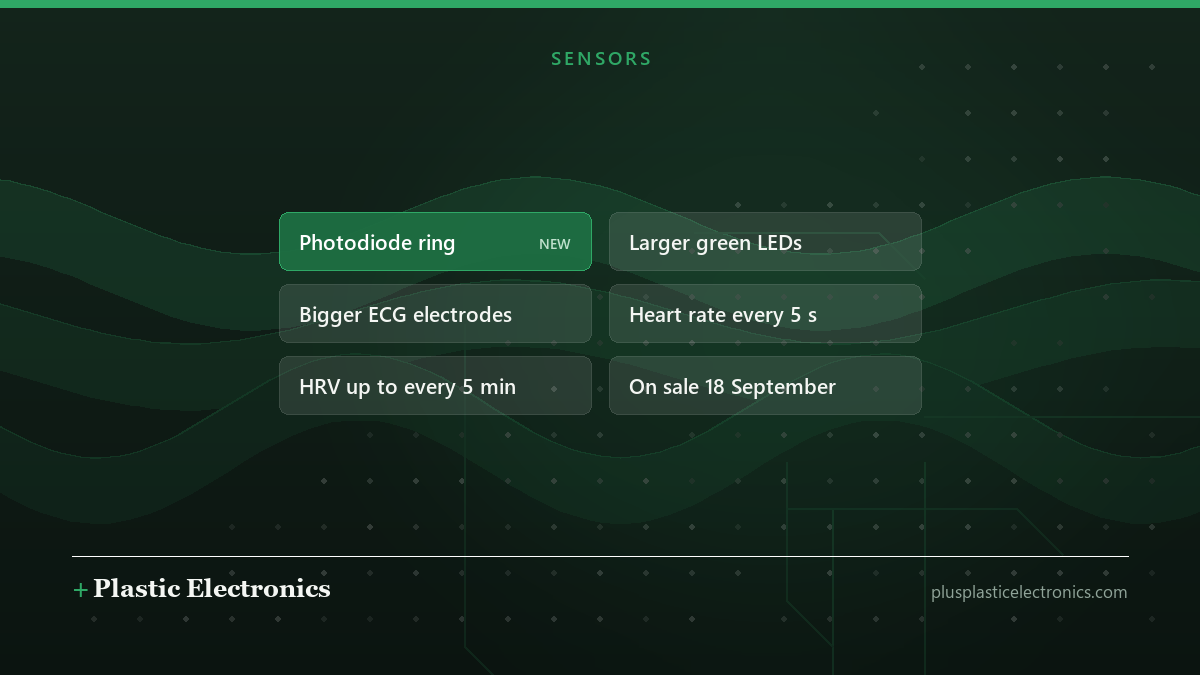
Apple announced a redesigned heart-sensing architecture for Apple Watch Series 12 and Apple Watch Ultra 4 on 9 September. Apple calls it the Health Sensing System, and it changes both the optical and electrical sensors on the back of the watch. According to MacRumors, the ECG electrodes have a larger surface area for better skin contact, the photodiodes are arranged in a ring to capture light more efficiently, and the green LEDs are larger and more power-efficient for heart-rate readings during motion.
More samples from the same wrist
The practical result is sampling frequency. Apple says the new watches measure heart rate every five seconds, all day long, and heart rate variability as often as every five minutes, 24 times more frequently than before. MacRumors reports that the five-second heart-rate interval is 60 times more frequent than on previous models.
For optical sensing, continuous high-rate measurement is a power problem as much as a sensor problem, because every reading means driving LEDs and amplifying photodiode signals. Larger, more efficient LEDs and better light collection from a ring of photodiodes are the hardware levers that make more frequent sampling affordable within a watch’s battery budget.
The accuracy claim
Apple says a study of more than 1,000 participants, run in July and August 2026 with representation across demographic groups, compared the new sensing with leading wearables and found Apple Watch had the highest heart-rate accuracy. The study was Apple’s own. The announcement does not name the devices it was compared with, and we have not seen the study published or independently reviewed. MacRumors’ account mentions no blood pressure features and no new regulatory clearances tied to the hardware.
Apple is also building more software on top of the sensors. MacRumors reports a daytime vitals toggle for comparing overnight and daytime measurements, separate recovery and overall heart rate variability values in the Heart Rate app, and a redesigned pedometer that uses improved machine learning to count steps. Each of those features depends on the sensor data being dense and clean enough to trust, which is the point of the hardware redesign.
Why it matters for sensor suppliers
Apple Watch is still the largest single venue for wrist-worn optical and electrical biosensing, and design choices made there tend to spread. A ring-shaped photodiode layout and larger electrodes change what the sensor window, back-cover materials and flexible interconnects underneath must accommodate. Higher sampling rates also raise the value of rejecting motion artefacts, which is where optical front-end and algorithm suppliers compete.
Series 12 starts at $399 and Ultra 4 at $799, with availability from 18 September, MacRumors reports. Apple says watchOS 27 was released on 14 September.
What we’re watching
- Independent validation of Apple’s heart-rate accuracy claim once the watches reach reviewers and researchers.
- Teardowns of the new sensor module and its photodiode ring.
- The effect of five-second sampling on battery life in everyday use.