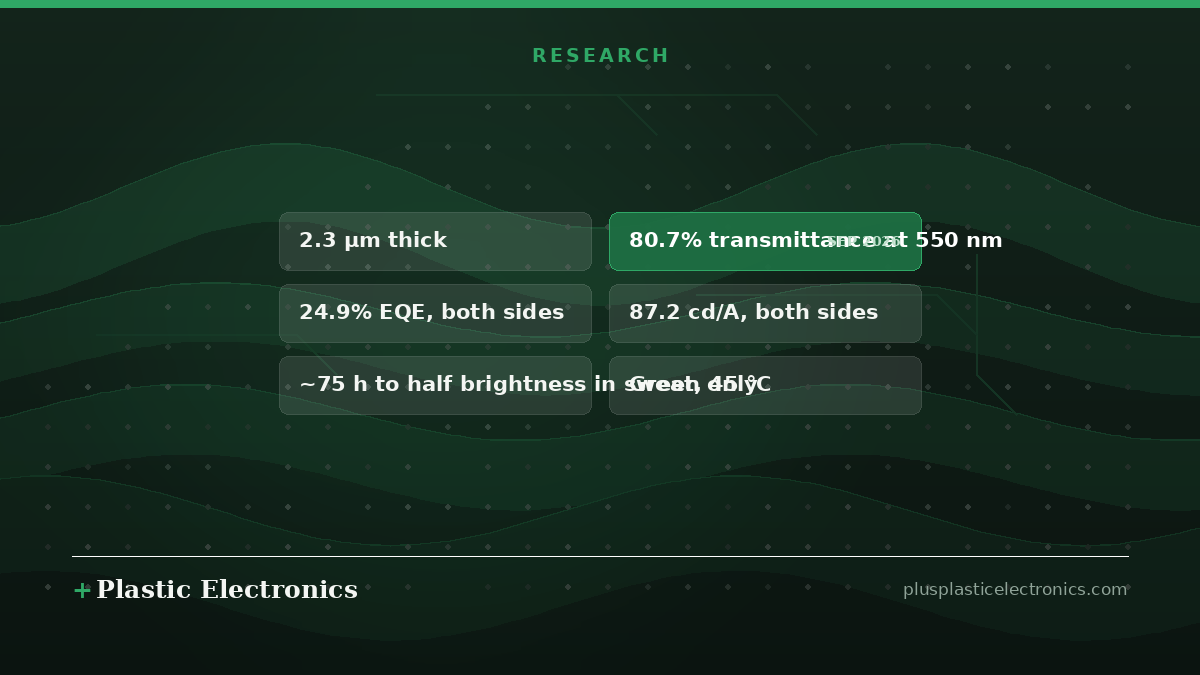
Researchers at Northeast Normal University and Jilin Normal University in Changchun, China, have made an OLED 2.3 micrometres thick that transmits 80.7% of light at 550nm when switched off and can be laminated onto skin. The work, led by Qingxin Tang, was published online in Advanced Functional Materials on 22 September. The authors say earlier flexible transparent OLEDs had not reached that level of transparency.
Two electrodes, two different problems
A see-through OLED needs both electrodes to be clear, and the usual answers fail on skin. Indium tin oxide cracks under repeated bending and its deposition can damage the organic layers beneath. Silver conducts far better, but nanowire networks leave protruding wires that pierce the stack, and silver films thin enough to see through tend to break up into islands.
For the bottom anode the team built the electrode back to front, as Nanowerk describes it: they deposited the conducting polymer PEDOT:PSS against a smooth silicon wafer, added silver nanowires, and welded the wires with a brief microwave treatment to cut resistance. Peeled off the wafer, the electrode presents a smooth polymer face to the organic layers with the silver network embedded behind it. It is a variation on the silver nanowire electrodes already used in flexible displays, with the roughness problem solved by burying the wires.
The top cathode is a silver film only 9nm thick. A little ytterbium in the silver and a lithium carbonate layer beneath it helped the metal form a continuous film rather than islands, and a tantalum oxide cap improved transparency further. Because the two electrodes ended up almost equally clear, the device emits through both faces in nearly equal amounts.
How to read the efficiency figures
The paper reports a peak current efficiency of 87.2cd/A and an external quantum efficiency of 24.9%. Both figures count light leaving both sides. That is a fair way to characterise the device, but it is not the light available to someone looking at one face of it, which is roughly half. On the authors' own comparison, most earlier transparent skin-mounted OLEDs stayed below 30cd/A.
Mechanically the results are good. At 2.3µm the film lies on skin without bubbles or wrinkles, and bending, folding, twisting and stretching by 30% changed its brightness only slightly. Its surface stayed below 39°C at full brightness. A temporary support bonded with a UV-curable adhesive, which loses its grip under further UV exposure, let the team release the fragile film without measurable loss of electrical performance.
What it is not yet
Lifetime is the clearest limit. Sealed on both faces with thin oxide and polymer barriers and run continuously in artificial sweat at 45°C, the devices fell to half their initial brightness after about 75 hours. That is a demanding test, but for anything worn for days it shows why encapsulation remains the hard part of skin-mounted electronics.
The demonstrations are modest. A 50 by 50mm sheet emitted uniform green light and kept working when bent. A skin-mounted temperature readout showed 36 to 39°C as green digits without hiding the skin, but it was tested on one person, only the display was transparent, and the sensor and driving electronics were opaque and connected by cables. The device emits only green; red and blue emitters, and a pixelated rather than segmented layout, are not reported. None of this detracts from the materials result, which is that an efficient emitter and a highly transparent, conformable film can now be the same layer.