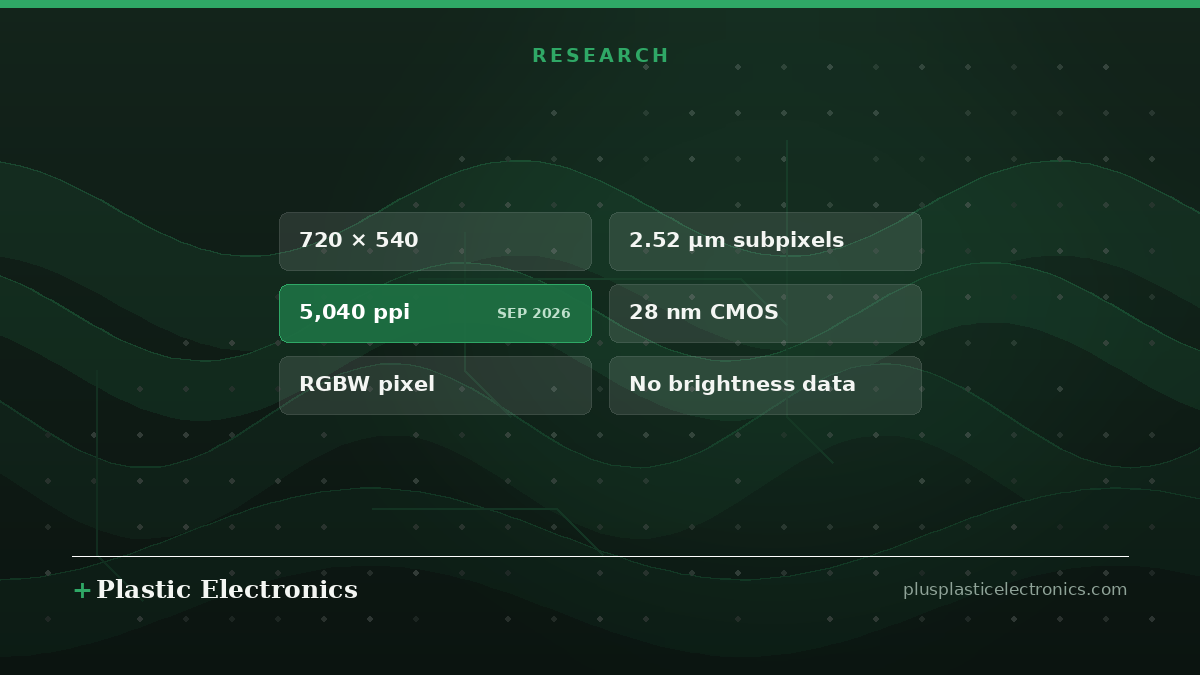
Fraunhofer IPMS has shown an OLED-on-silicon microdisplay with 2.52 by 2.52 micrometre subpixels — a pixel density of up to 5,040 per inch, which the institute says makes them the smallest OLED pixels demonstrated to date. The work was presented at Eurodisplay 2026, held in Dublin from 22 to 24 September.
The specification
The panel is 720 by 540, built on a 28 nanometre CMOS backplane. Shrinking the process node is what makes the pixel pitch possible: on an OLED-on-silicon device the limit is not the organic stack but how much drive circuitry has to fit underneath each subpixel, and a smaller node buys the room to put it there.
The pixel is RGBW rather than RGB. A white subpixel sits alongside the three colours and carries the luminance that would otherwise have to come from driving all three hard, which is the standard way to buy efficiency at the cost of some colour volume. What is less standard is where the white comes from: an integrated White Calculation Block in the backplane derives the white subpixel from ordinary RGB image data, so the host does not have to be aware of the fourth channel.
Two ways to drive it
The more interesting choice is the backplane's dual driving architecture. A frame-based mode handles continuously updating content in the normal way. A memory-based mode holds static content in the pixel, so an image that is not changing costs almost nothing to keep on screen.
That matters for the application Fraunhofer is aiming at. Head-worn AR and MR displays spend much of their time showing something that barely moves — a notification, a label pinned to an object, an instrument reading — and a conventional display redraws all of it, every frame, regardless. Paying only for change is how a battery-powered pair of glasses gets through a day. Philipp Wartenberg, who heads IC and system design at Fraunhofer IPMS, is quoted on the efficiency advantage the combination brings.
What was not said
No brightness, efficiency or lifetime numbers accompanied the announcement, and for a microdisplay those are the figures that decide whether it can be used. Head-worn optics are lossy; a panel that cannot reach high luminance will not survive the waveguide, and small emitting areas driven hard are exactly where OLED lifetime becomes difficult. “Lowest power consumption” and “bright enough for AR” are claims in tension, and only one of them has been made here.
Read alongside the rest of this month, though, the direction is consistent. Getting more pixels per degree into a headset is now a patterning problem, which is why ETH Zurich's work on emitters that survive photolithography matters, and why Meta's move to micro-OLED put the display at the centre of its headset design. Fraunhofer's answer is to attack it from the backplane instead of the emitter.