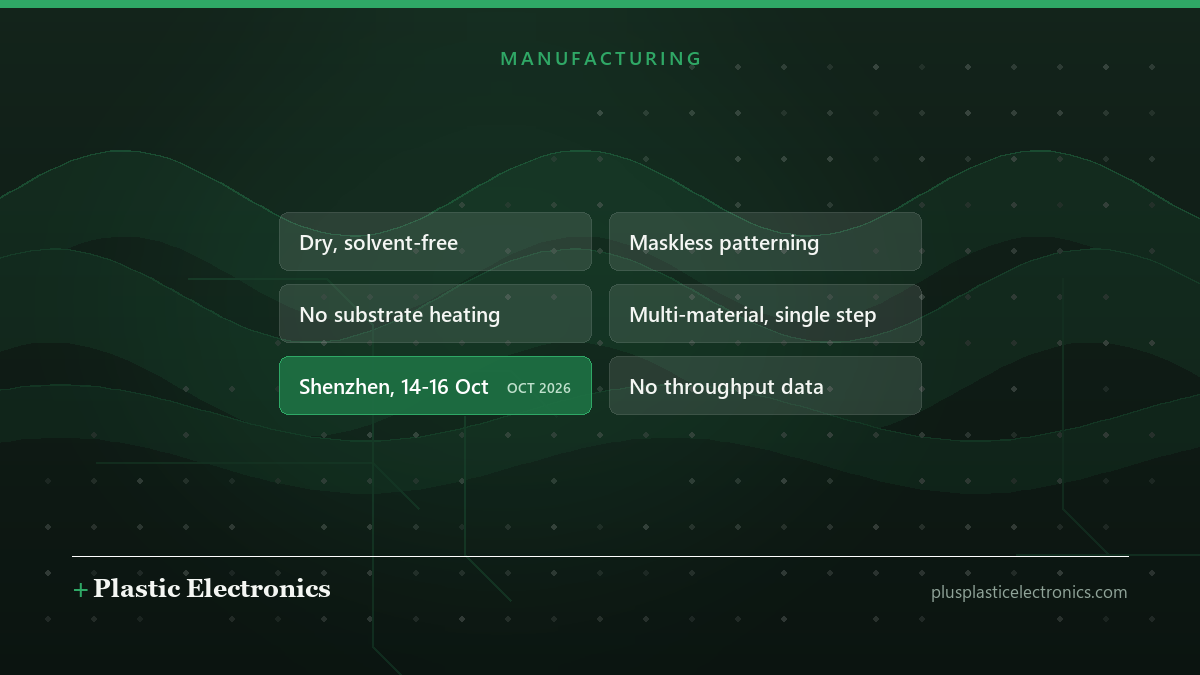
Universal Display Corporation's Singapore subsidiary said on 21 September that it will show its first commercial deposition machine next month, and that it is pitching it at chipmakers rather than display fabs. Universal Vapor Jet Corporation will unveil the tool, called NovaJet, at the WESEMiBAY Semiconductor Ecosystem Conference and Expo in Shenzhen from 14 to 16 October.
Dry, maskless, and no substrate heating
NovaJet is the first commercial system built on what UVJC calls its Universal Vapor Jet Printing platform. The company describes it as a dry, solvent-free and maskless process for digitally patterned thin-film deposition — material is delivered where it is wanted rather than coated everywhere and then subtracted.
Two claims in the announcement matter more than the rest. The first is that the process does not require the substrate to be heated, which is what determines whether a deposition step can be used on temperature-sensitive materials at all. The second is that multiple materials, and graded compositions between them, can be laid down in a single step. Taken together, UVJC's argument is that a patterned film arrives without the solvents, masks, drying and lithography-related steps that the alternatives need.
“NovaJet is an important step in bringing UVJP closer to real-world manufacturing,” said Chandran Nair, chief executive of UVJC.
Aimed past displays
The framing is the notable part for anyone who has followed organic vapour jet printing. The technology has spent years being discussed as a way to deposit OLED emitters without fine metal masks, which are the practical limit on subpixel density in evaporated OLED production. UVJC is launching it into a semiconductor show instead, under the banner of an industry looking beyond traditional scaling, and lists semiconductors, advanced packaging, new material systems, life sciences and renewable energy among the targets. Displays remain on the list, but they are no longer the headline.
That fits a wider pattern this month, with equipment and capacity being repositioned towards packaging — the same logic that has Taiwan's panel makers offering their glass lines to the chip-packaging industry. Advanced packaging is where the money is, and a deposition tool that can pattern without a mask has an obvious story to tell there.
What will be on the stand
Visitors to booth 8G03 will see a scale model rather than the machine itself, shown alongside coated substrates and printed samples produced on the production system that UVJC says is installed and running at its Singapore headquarters and R&D facility. The company will also give a presentation on 15 October titled “Enabling Dry and Patterned Thin-Film Printing for Next-Generation Manufacturing”.
UVJC was established in 2024 and is a wholly owned subsidiary of Universal Display Corporation, the company behind the phosphorescent OLED emitter licensing business. It has committed to investing $39m over the coming years in tools, equipment and talent, according to OLED-Info, and is working with three of Singapore's A*STAR institutes: the Institute of Microelectronics, the Institute of Materials Research and Engineering, and the Singapore Institute of Manufacturing Technology.
The gap between a launch and a line
No throughput, substrate size, yield or material-utilisation figures were disclosed, and those are the numbers that decide whether a dry patterning tool displaces anything. A scale model at a trade show and a production system in a Singapore R&D facility are both a long way from a qualified process step in a customer's fab. Solvent-free deposition is nonetheless the direction the industry keeps pointing at, for reasons that are partly environmental and partly about the cost of the materials being deposited, and it belongs in the same conversation as the continuous processes this industry has been trying to make pay for two decades.