LG Display will use FLiPP, its process for making OLED panels without a fine metal mask, first for laptops and monitors rather than smartphones. The company set out the plan and its first detailed process figures at an online technical seminar on 8 October, as reported by The Elec, and its chief technology officer, Choi Young-seok, told the Seoul Economic Daily that FLiPP yields 24% more panels from a mother glass of the same size than the mask-based method. FLiPP itself is not new: LG Display unveiled it at the IMID exhibition in Busan in August. What is new is where it goes first and what it is claimed to save.
What replaces the mask
In a conventional OLED line, red, green and blue emitters are evaporated through a fine metal mask, a thin sheet perforated with one opening per subpixel. The masks are expensive, sag and distort over large areas, and waste most of the material that misses the openings. FLiPP, short for FMM-Less innovative Pixel Patterning, instead coats the organic layers across the whole substrate and removes what is not wanted. The Elec describes photolithography and etching used to define each colour in turn; the Seoul Economic Daily describes ultraviolet light used to remove organic material that spreads beyond the pixel cells.
The hard part of any such process is that OLED materials are damaged by the solvents, light and heat of a lithography step, which is why other groups have tried to make the emitters themselves photo-patternable, and why vapour-jet printing avoids masks by printing material only where it is needed. LG Display has not said how it protects the stack between patterning steps.
The claimed gains
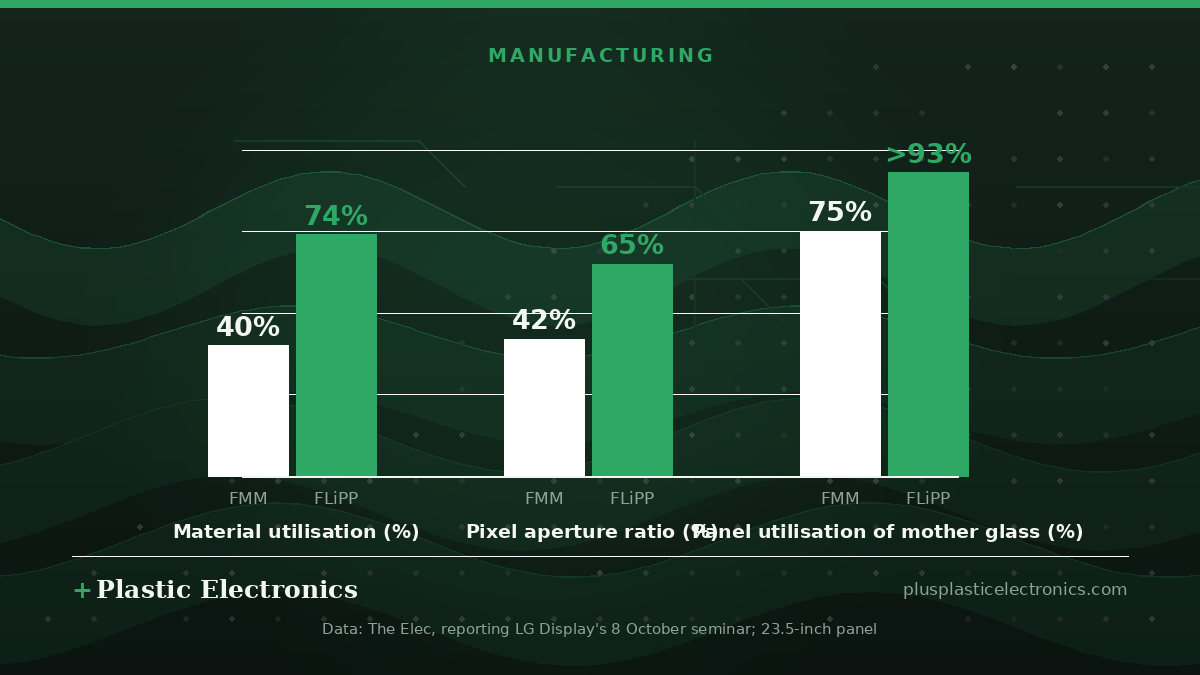
For a 23.5-inch panel, The Elec reports, FLiPP raises the share of the mother glass used for panels from 75% to more than 93%, organic material utilisation from 40% to 74%, and the pixel aperture ratio from 42% to 65%, and cuts deposition time by about 40%. The utilisation figures are consistent with the CTO's 24% gain in output, since 93 divided by 75 works out at about 1.24. The larger aperture can be spent in one of three ways, LG Display says: 1.6 times the luminance, 2.4 times the lifetime, or 13% less power. These are alternatives, not a combined gain, though some coverage since IMID has presented them together.
LG Display's argument against the rival photolithographic routes, Visionox's ViP and JDI's eLEAP, is substrate size: it says FLiPP forms RGB pixels directly on an uncut eighth-generation mother glass. At IMID, according to The Korea Times, it put the gain in mother-glass utilisation from avoiding divided substrates at up to 64%.
Why IT first, and what is missing
Choi said the IT OLED market "has yet to mature sufficiently" and that conventional manufacturing struggles to meet both its cost and technical requirements. Phones will stay on masks for now, although LG Display said FLiPP could later suit them; its target of up to 1,000 pixels per inch still needs technical verification. After IT panels, the Seoul Economic Daily reports, the company sees wearables and televisions up to 100 inches.
Much is not disclosed. There is no mass-production date, which The Elec says depends on winning customers and settling specifications, and no investment figure. The company will spend about a year working out which existing LCD and OLED equipment can be reused. It has published no yield data for the patterning steps, and no lifetime measured on finished panels as opposed to the gain the aperture ratio allows in principle.