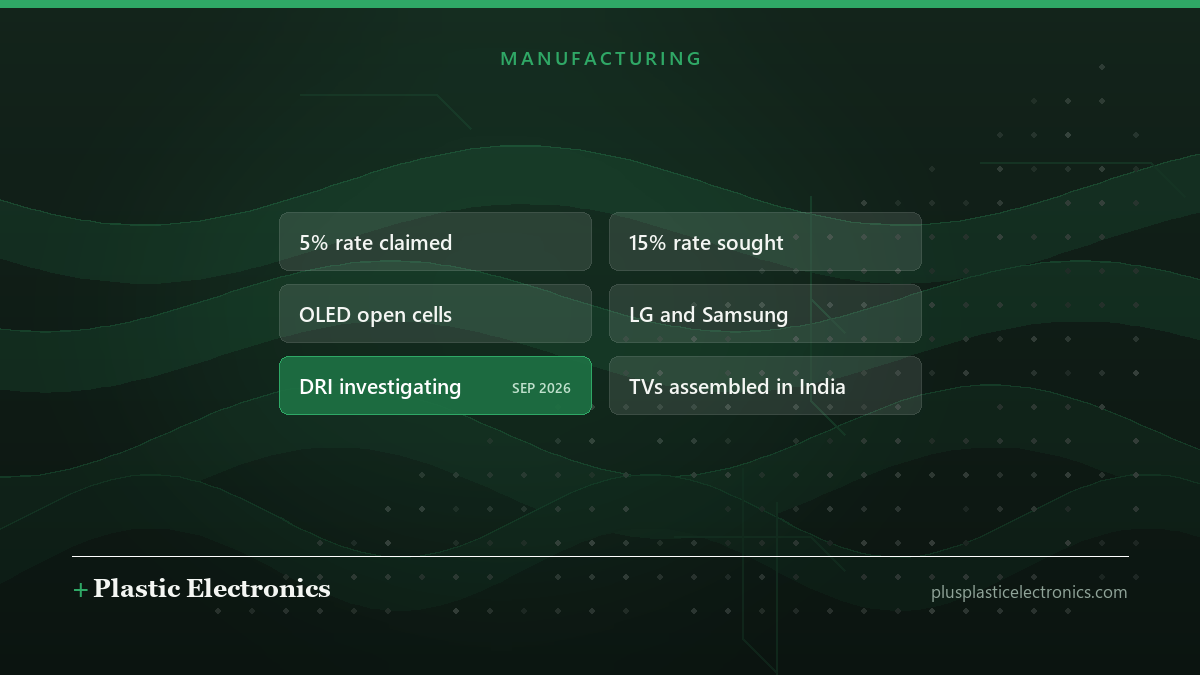
India's Directorate of Revenue Intelligence is investigating whether LG Electronics and Samsung Electronics underpaid customs duty on the display parts they import to build high-end televisions in India, according to a Reuters report published on 23 September and summarised by OLED-Info. At issue is a ten-percentage-point gap between two tariff lines and the question of what, for customs purposes, an OLED actually is.
The argument
The parts in question are open cells: the glass panel sub-assembly that is imported and then finished into a complete panel and a television locally. India applies a concessional 5% rate to open cells, a rate that officials say has for years been understood to cover the LCD and LED panels that make up the mass market. Both companies are reported to have claimed that rate on OLED open cells, on the argument that OLED is an advanced form of LED technology and belongs in the same line.
The DRI's position, as reported, is that OLED parts attract 15%. Neither the duty allegedly short-paid nor the volume of imports involved has been made public, and the reporting does not set out what the companies have said in response.
Why the category fight is not pedantry
Tariff classification disputes read as paperwork until you notice what they are really about. India's concessional rate on open cells exists to encourage local assembly: import the hard part, add value domestically, pay less. That policy was written when the hard part was an LCD. An OLED panel is a different object made on a different line by a different set of suppliers, and it sits at the premium end of a market where India is growing fast — which is exactly why the rate it attracts is worth arguing over.
The same tension runs through the rest of India's electronics policy. The component incentive schemes are designed to pull value up the chain rather than reward final assembly, and the pitch at events like SEMICON India is that the country wants to make the difficult pieces, not just screw them together. A tariff that treats an imported OLED panel as cheaply as an imported LCD one cuts against that.
What to watch
Investigations of this kind normally proceed to a show-cause notice before any demand is confirmed, and classification disputes in India are frequently settled by a clarification from the finance ministry rather than by a finding against a company. The more consequential outcome would be a formal ruling that OLED open cells sit outside the concessional line, because that would apply to every importer and would change the landed cost of premium television manufacturing in India.
It lands at an awkward moment for the panel makers, who are already managing a flat year in flexible OLED shipments and looking to premium segments to carry margin. India is a growth market for both companies, and a rate change there would not be fatal — but it would be one more cost in a year where the display industry has not had many places to find one.