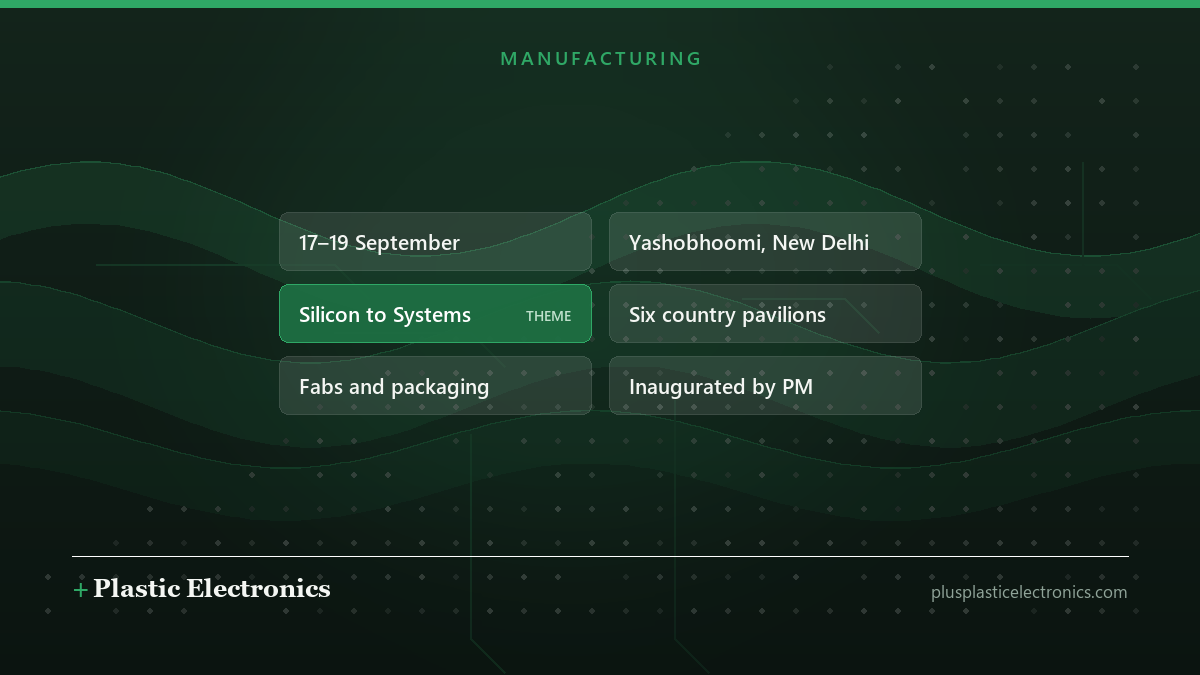
SEMICON India 2026, the fifth edition of the country’s main semiconductor trade event, opens on 17 September at Yashobhoomi, the India International Convention and Expo Centre in New Delhi. Prime Minister Narendra Modi is due to inaugurate it. The three-day event is organised by the India Semiconductor Mission (ISM), the Ministry of Electronics and Information Technology (MeitY) and the industry body SEMI, under the theme “Silicon to Systems: Building the Ecosystem”.
What is on the agenda
The ISM’s event page lists planned sessions on semiconductor fab projects, advanced packaging, smart manufacturing, AI integration, workforce development, sustainability, compound semiconductors and start-ups. According to Deccan Chronicle, the show will also feature a student hackathon, a workforce development pavilion, a women’s forum, a start-up pitch competition and an innovation showcase, with about 40 start-ups in a dedicated pavilion.
How big? The figures differ
The published numbers for the event do not agree. Deccan Chronicle reports more than 600 exhibitors, including 300 international companies, across 15,000 square metres, with more than 150 speakers, six country pavilions and 12 state pavilions. The ISM event page, last updated on 4 September, instead gives an exhibition area of about 18,000 square metres, more than 300 Indian and more than 100 international companies, and representation from more than nine states.
The ISM page names the six country pavilions as Japan, Korea, the Netherlands, Singapore, Malaysia and Sweden. The Deccan Chronicle report we read does not list them. Until the show opens, readers should treat the final exhibitor and pavilion line-up as unsettled.
The policy backdrop
Deccan Chronicle reports that 12 semiconductor projects have been approved under the Semicon India Programme, three of them in commercial production, and that a Semicon 2.0 phase with six pillars has been approved. It also reports that more than 400 academic institutions and 105 start-ups have been equipped with design automation tools, and that 24 start-ups have been approved under the Design Linked Incentive scheme. The same report puts India’s semiconductor demand at about $50 billion today, rising to $103 billion by 2030. It does not name the source of those projections, and we have not verified them.
Why it matters for flexible and printed electronics
SEMICON India is a silicon event, but the “systems” half of its theme, meaning packaging, assembly, displays and components, is where India’s flexible and printed electronics ambitions connect to national policy. The same day, the OE-A and VDMA symposium takes place in Bengaluru, which we previewed in our report on the OE-A India delegation. The advanced packaging sessions, and any announcements on display or component manufacturing, are the parts of the SEMICON programme most relevant to this publication’s readers. For the component incentives behind that push, see our analysis of India’s component scheme.
What we’re watching
- Project approvals or investment commitments announced around the inauguration.
- Announcements on display fabrication or advanced packaging, the areas closest to flexible electronics.
- Final exhibitor and pavilion figures, given the discrepancies in the pre-show material.