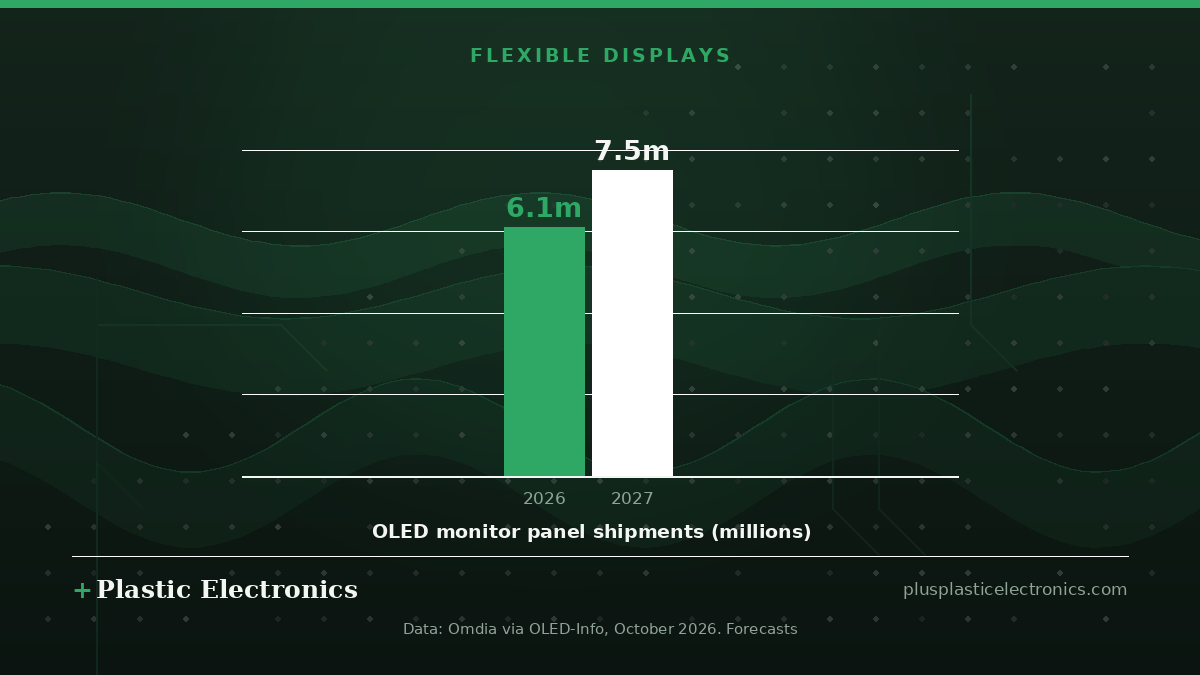
Omdia expects 6.1 million OLED panels for desktop monitors to ship worldwide in 2026, 79% more than in 2025, and 7.5 million in 2027. The research firm published the forecast in the first week of October; Omdia's own release blocks automated readers, so the figures here are as reproduced by OLED-Info on 8 October and by Netzwoche and Multiplayer.it, which agree on them. Taken together, the two growth rates imply 2025 shipments of roughly 3.4 million panels, a figure that works out from Omdia's numbers rather than one Omdia stated.
Price is the driver
Omdia's explanation is straightforward: panels have become cheaper and monitors with them. According to OLED-Info, the price of 27-inch, 240Hz OLED gaming monitors has fallen by more than 40% in 2026. Gaming remains the main source of demand, Netzwoche reports, with content creation and commercial use as secondary markets.
That fits what panel makers have been building, with refresh rate rather than resolution as the main selling point in gaming. LG Display's 24.5-inch, 720Hz panel for esports is an extreme example of a panel designed for a single use.
Who buys, and who supplies
ASUS is expected to remain the largest buyer of OLED monitor panels in 2026, with 23% of shipments, followed by MSI, Samsung and TPV. MSI and TPV are forecast to increase their purchases significantly, to 14% and 12% respectively. LG Electronics, Dell, Acer and Lenovo follow. Netzwoche notes that the early adopters, ASUS, Samsung, LG and Dell, dominated from 2023 to 2025 but are losing share as HKC, KTC and Gigabyte enter.
Supply has so far come from two companies using two technologies: Samsung Display with QD-OLED and LG Display with white OLED. Omdia now counts TCL CSOT as a third supplier. Its panels are made by inkjet printing, a route this publication follows closely because it deposits the emitters from solution rather than evaporating them through a metal mask. Netzwoche reports that TCL CSOT planned to supply 27-inch panels to MSI from the third quarter of 2026, and that Omdia expects a second TCL facility in 2028 producing 32-inch and 34-inch panels with refresh rates up to 700Hz. For now, OLED-Info notes, TCL CSOT's capacity is limited.
What the forecast leaves out
The published summary does not split shipments between QD-OLED and white OLED, or give each panel maker's share, which is the number that matters most for suppliers of materials and equipment. It does not give panel prices, only the fall in finished monitor prices. Nor does it address durability. Burn-in remains the standing objection to OLED on a desktop, where taskbars and toolbars sit still for hours, and a shipment forecast says nothing about how many buyers will run into it.
The figures should also be read for what they are: a forecast from one firm, issued with a quarter of the year still to run. Longer-range OLED market outlooks rest on the same assumption, that falling cost will carry OLED out of premium niches. Monitors are one of the clearest tests of it so far.