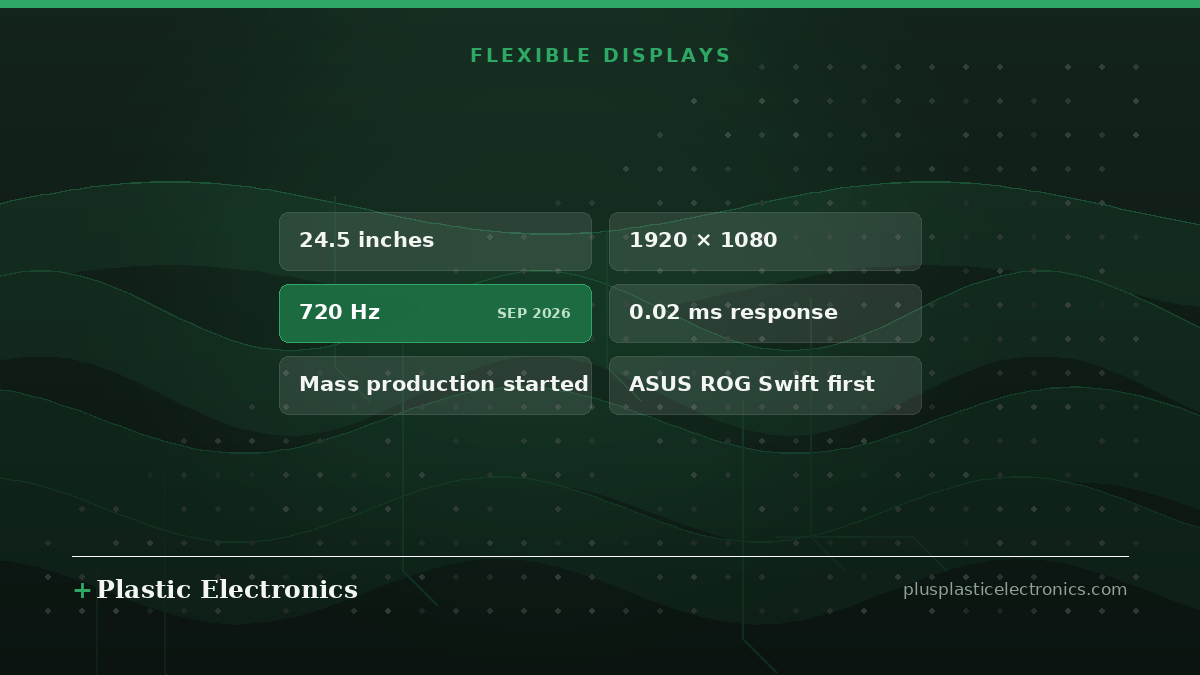
LG Display has started mass production of a 24.5-inch OLED monitor panel that runs at 720Hz, which it says is the highest refresh rate of any gaming OLED panel and the first designed specifically for esports. The panel is full HD — 1920 by 1080 — and quotes a 0.02 millisecond response time. It was announced on 21 September.
Deliberately small, deliberately low-resolution
Every specification here is a trade made in the same direction. Competitive play at this level is done on a small screen that fits inside the field of view without eye movement, and at a resolution low enough that the pixels can be refreshed 720 times a second. Driving 1080p that fast is roughly the same pixel rate as driving 4K at about 180Hz; spending it on temporal resolution rather than spatial resolution is a decision about what the display is for, not a limitation.
LG Display credits a proprietary driving algorithm for holding the panel stable at 720Hz. That is the hard part: an OLED pixel can switch far faster than an LCD one, so the emitter was never the constraint, but getting charge into every row of a panel within a 1.4-microsecond window and keeping luminance uniform while doing it is a backplane and driver problem.
Where it shows up
The first product is ASUS's ROG Swift OLED PG259QWS Ace, which has been chosen as the official monitor of the PGL CS2 Major Singapore 2026. That is the point of the exercise as much as the specification is: tournament use is how a panel becomes the default for the players who buy monitors on the strength of what they saw on stage.
Hyeon-woo Lee, who heads LG Display's large display business unit, framed it as leading “the transition to OLED in the gaming monitor market”. The company says its gaming lineup will span 20 to 40 inches, with some panels carrying Dynamic Frequency & Resolution, which trades one against the other depending on content.
Why a rigid panel matters to this industry
This is a glass panel for a desktop monitor, not a plastic one, and it is fair to ask what it has to do with flexible electronics. The answer is where the volume goes. Monitor and IT panels are the segment the OLED industry is counting on for growth while phone panel shipments stay flat, and they are the reason materials suppliers are forecasting IT to outgrow mobile several times over. A halo product that makes OLED the thing serious players demand is part of how that conversion gets paid for.
It also shows how far the technology's centre of gravity has moved from the premium phone. Not long ago every notable OLED announcement was about a fold or a crease. Increasingly they are about panels for things that sit on a desk.