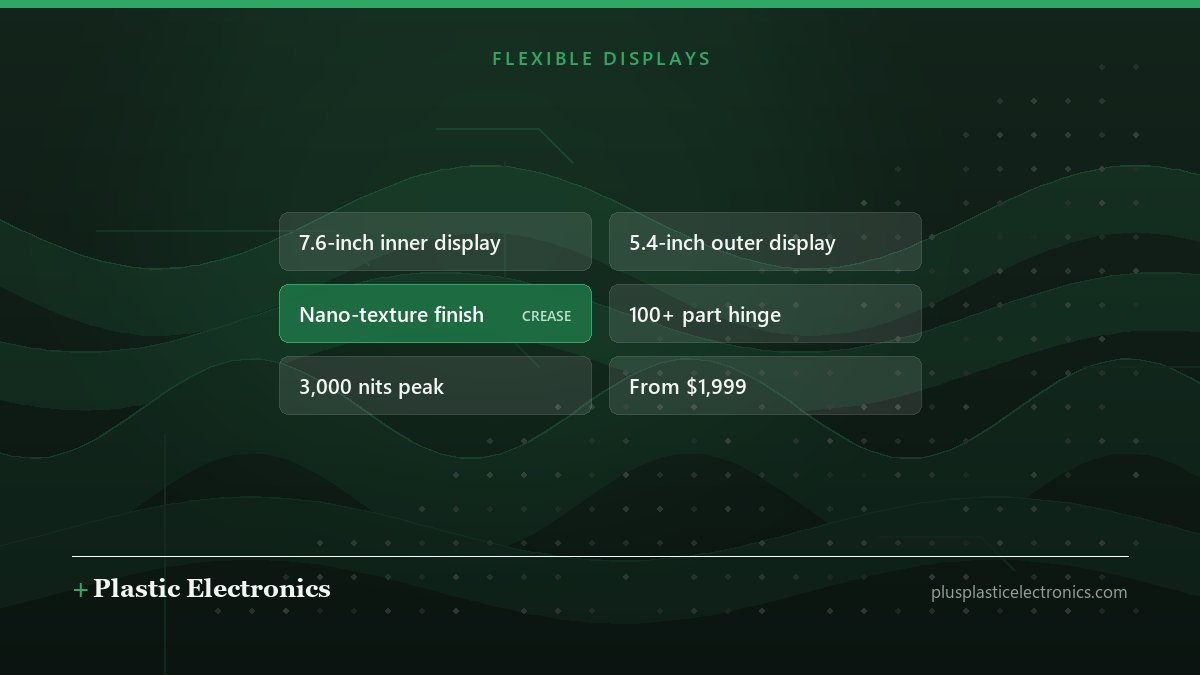
Apple unveiled iPhone Duo, its first foldable phone, on 9 September. The device opens like a book to a 7.6-inch inner display and has a 5.4-inch outer display when closed, and Apple calls it the thinnest iPhone it has made when fully open. Pre-orders begin on 16 October, and it goes on sale on 23 October in more than 70 countries, starting at $1,999.
The crease question
For the flexible display industry, the most telling detail is what Apple does not claim. Its announcement says the nano-texture finish on the inner display “minimizes crease visibility”. It does not say the crease is gone. MacRumors reports that Apple also uses a “micro lens texture”, made with maskless laser lithography, to make the fold less visible.
That is an optical answer to a mechanical problem. A folding OLED stack bends around a hinge thousands of times, and the cover layer at the fold deforms. Most foldable makers have attacked the crease through hinge geometry and support plates. Apple’s emphasis on surface treatment suggests it has accepted a residual crease and chosen to hide it, using the same nano-texture to cut glare.
The displays
Apple’s specifications give the inner Super Retina XDR display as 7.58 inches measured diagonally and the outer display as 5.36 inches, with both sharing the same aspect ratio. According to Apple, the inner screen is 50% larger than the iPhone 18 Pro Max display, and the outer screen offers 90% of the iPhone 18 Pro’s screen area. The inner display supports ProMotion and Always On, with 3,000 nits peak brightness.
Apple says the hinge is “engineered from more than 100 components” with an integrated magnet array. The frame is grade 5 titanium, the outer display uses Ceramic Shield 2, and the phone is rated IP68. Apple publishes no fold-cycle rating and does not name the panel supplier. MacRumors reports battery life of up to 31 hours of video playback on the inner display.
MacRumors also reports up to 44 hours of video playback on the outer display and 24 hours with equal use of both screens. The gap between the inner and outer figures is a useful reminder of how much power a large folding panel draws, even with ProMotion. The phone uses Apple’s A20 Pro chip, the same processor as the iPhone 18 Pro, according to MacRumors.
Why it matters
Apple’s entry into foldables matters less for its first-year volumes than for what it signals to the supply chain. Panel makers, hinge suppliers and cover-film producers will now design to Apple’s specifications. Its decision to lead with surface optics, rather than claiming a crease-free fold, may also shape how the rest of the industry markets its own devices.
What we’re watching
- Teardowns identifying the panel supplier and the layer stack behind the micro-lens finish.
- Independent fold-durability testing once devices ship on 23 October.
- Whether rival phone makers adopt laser-patterned surface textures on their own foldables.