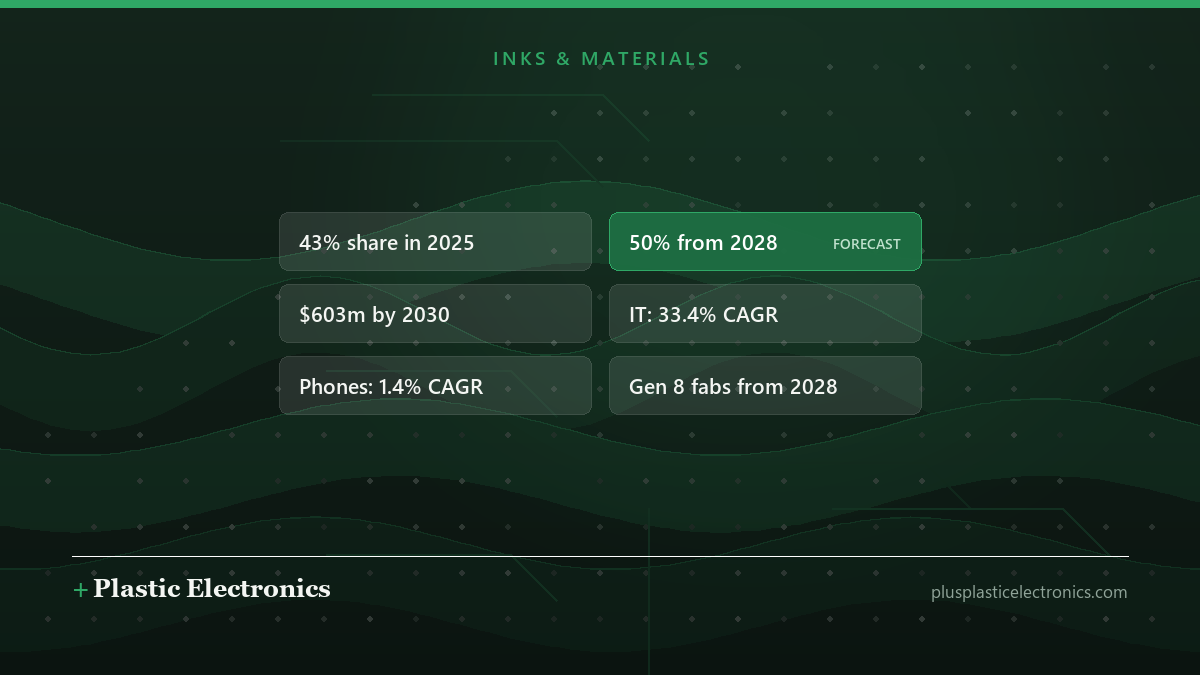
Counterpoint Research expects Chinese suppliers of AMOLED materials to reach half of their home market by 2028, up from 43% of OLED materials sales in China in 2025, and to generate $603m of revenue by 2030. The forecast, from the firm's AMOLED Materials Report, was reported on 22 September.
The fabs decide it
The mechanism is straightforward and worth stating plainly: materials localise when the fabs that consume them are local and new. Counterpoint points at 2028, when Gen 8 OLED lines from BOE, TCL CSOT and Visionox are expected to be in full-scale operation. A fab being brought up is the moment its materials set gets chosen, and a domestic supplier has a far better chance of qualifying into a line being commissioned next door than of displacing an incumbent on a line that has been running for years.
That is why share moves in steps rather than smoothly, and why the 2028 date carries so much of the forecast. Qualification cycles for emitter and transport materials are long, and the switching cost on a running line is high enough that nobody does it casually.
Where the growth actually is
The split underneath the headline is the more useful number. Counterpoint has IT applications — laptops, tablets, monitors — growing at a 33.4% compound annual rate between 2026 and 2030, against 1.4% for mobile phones. By 2028 it expects IT to displace TV as the second-largest segment of global AMOLED material revenues, at 23%.
Phones are effectively finished as a growth story for materials volume. The panels are already OLED, the units are not growing, and shipment forecasts for flexible OLED are close to flat. IT is where the area is: a laptop panel is many times the area of a phone panel, and the conversion from LCD has barely started. Materials consumption tracks area, not units, which is why a segment growing modestly in units can grow dramatically in materials revenue. The report carries commentary from Counterpoint's Guillaume Chansin and Bob O'Brien.
The number in context
$603m by 2030 is worth keeping in proportion: it is the revenue of Chinese suppliers within a global OLED materials market that is considerably larger, not the whole market. The forecast is a statement about who captures value in China, not about the industry's total size.
It fits a pattern this publication has been tracking all month. Materials cost is under pressure across the board — it is why silver-flake inks are losing ground and why copper alternatives are attracting strategic money. Localisation is the same instinct applied to a different part of the stack: when the input is expensive and the supply chain is long, the buyer eventually funds someone closer to home.