Researchers at the University of California San Diego, Princeton University and Sungkyunkwan University in South Korea have found a way to grow solution-processed perovskite films with larger, cleaner crystals by letting a liquid form briefly between the grains and then disappear. The work, led at UC San Diego by David Fenning, was published in Science on 8 October. The journal's page blocks automated access; the details below are from the university's release as carried by TechXplore and from TaiyangNews, which agree on the figures.
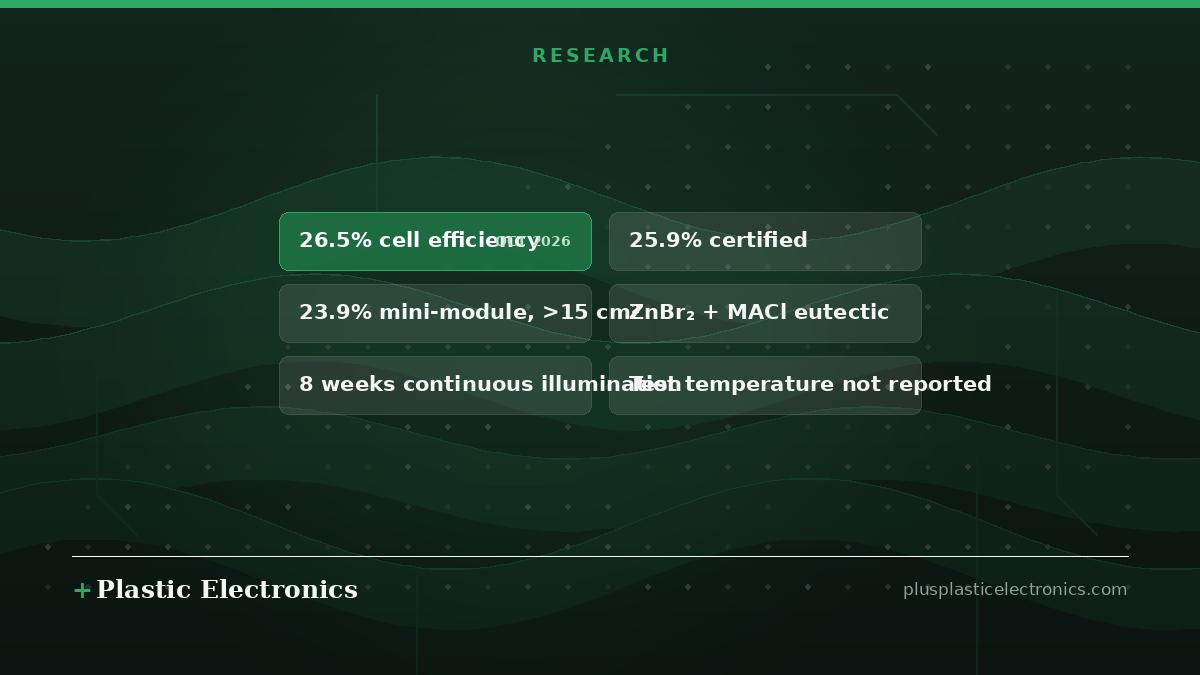
Solar cells made with the method reached 26.5% power conversion efficiency, with an independently certified 25.9%. Mini-modules larger than 15cm² reached 23.9%.
Why grain boundaries matter, and what the additive does
Depositing perovskite from solution is what makes it attractive for printing and roll-to-roll coating, but the resulting film is a mosaic of small crystals. Defects at the boundaries between them trap charges, which recombine before they can be collected, and the boundaries are also where degradation tends to start.
The team added two salts to the precursor solution: zinc bromide and methylammonium chloride. On heating, the pair form a eutectic, a mixture that melts at a lower temperature than either component alone. That creates a liquid phase around the crystal boundaries during annealing, in which the crystals can rearrange into larger and more orderly grains. As heating continues the methylammonium chloride evaporates, while the zinc stays behind at the boundaries and neutralises electronic defects there. The researchers followed the solid-liquid-solid sequence with nanoprobe X-ray diffraction at beamline 26-ID-C of the Advanced Photon Source.
"We introduce a new way of tuning the growth of halide perovskites by developing an additive mixture that actively evolves during crystallization," said co-author Connor Dolan, as quoted by TaiyangNews. In the release carried by TechXplore he also said the films had the longest-lasting electron-hole pairs ever reported for any direct-bandgap semiconductor; neither report gives the lifetime figure itself.
Where the evidence is thin
The stability result is modest by the standards the field now sets. The cells "retained most of their original efficiency" after eight weeks of continuous operation under simulated sunlight, according to the release. That is about 1,340 hours, worked out from the stated period; neither report says what fraction of efficiency was retained, at what temperature, or under what load. Outdoor performance and damp-heat testing are not mentioned.
The release says light-emitting diodes made with the same perovskites, as well as solar cells, reached efficiencies of about 24% to 26%. It does not say what colour the LEDs emit, which efficiency measure is meant, or how long they lasted, and LED operating lifetime has generally been a harder problem for perovskites than efficiency. The claim should be checked against the paper before it is relied on.
The method also leaves zinc in the film. The authors present that as the point, since the zinc passivates the boundaries, but how residual zinc behaves over years of heat and light is not addressed. And while 23.9% on a mini-module is encouraging, 15cm² is still a laboratory size. The group says it is now looking for other eutectic chemistries so that the approach can be generalised for scalable production.
For readers following perovskites in tandem with organic absorbers, the result is relevant mainly as a film-quality tool rather than a new record: the perovskite-organic tandem work this year depends on exactly this kind of control over the perovskite layer's defects.