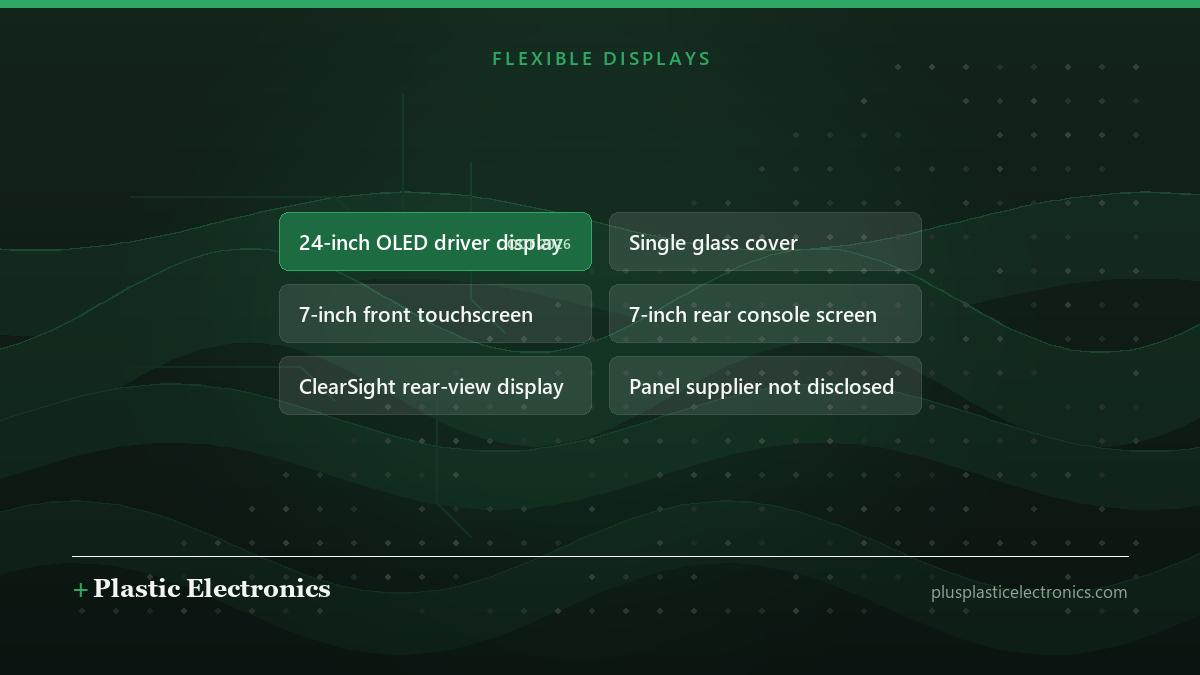
Jaguar revealed its Type 01 electric grand tourer in New York on 6 October, the brand's first new model in more than five years, and its cabin is built around one display: a 24-inch OLED that sits directly ahead of the driver and carries both the instruments and Jaguar's new infotainment system. JLR describes it as a “single glass 24-inch OLED screen”, chosen, the company says, for brightness and clarity.
Everything else is small. A 7-inch smartphone-style touchscreen between the front seats handles climate, audio and other frequently used functions, and a matching 7-inch portrait screen sits in the rear centre console. The interior mirror is replaced by a ClearSight rear-view display set into a full-width speaker bar at the base of the windscreen, fed by a camera system that JLR says uses 10 external cameras, five radars and 12 ultrasonic sensors.
One large panel, not a row of screens
The layout is the opposite of the trend toward pillar-to-pillar dashboards, in which a run of screens spans the whole width of the car and the passenger gets a display of their own. Jaguar has instead concentrated the area in front of the driver and kept the centre stack to a phone-sized screen. For a display maker the difference matters: a 24-inch automotive panel behind one curved or flat cover glass is a single high-value part, where a pillar-to-pillar layout is usually several.
OLED-Info, which reported the reveal on 7 October, noted that a display this size could be built from several tiled panels behind one piece of glass, and that the construction has not been confirmed. That is a real distinction. A monolithic 24-inch automotive OLED is a more demanding part than two smaller panels bonded seamlessly, and the two routes favour different suppliers.
What Jaguar did not say
The announcement leaves out most of what would tell the display industry how significant this is. JLR's release names no panel supplier. It gives no resolution, peak brightness, refresh rate or curvature, and it does not say whether the display is a rigid OLED on glass or a flexible plastic-substrate panel laminated to a shaped cover. Nor has Jaguar said whether the two 7-inch screens are OLED as well; OLED-Info notes that their technology was not disclosed.
Automotive OLED also carries trade-offs that a launch release does not dwell on. Cars need panels that survive high cabin temperatures and stay legible in direct sunlight, and an instrument display shows static elements for hours at a time, which is the condition under which OLED burn-in develops. Suppliers manage this with tandem stacks, pixel shifting and brightness limits, but none of those choices is described here.
Timing
The Type 01 is not a near-term volume product. JLR quotes a US starting price of $130,500, with orders expected to open in early 2027 and first deliveries in the second half of that year. Its 118kWh battery gives an anticipated EPA range of up to 400 miles, which Sports Car Digest notes is a manufacturer estimate rather than a certified figure. The car is designed and engineered in the UK.
For panel makers, the value of a car like this is less in its numbers than in the signal. A large single OLED in front of the driver of a luxury car is the kind of specification that migrates down a range over a model cycle, and it adds to the demand that has made automotive one of the segments the OLED industry is counting on as phone volumes flatten. Who supplies it is the question Jaguar has left open.