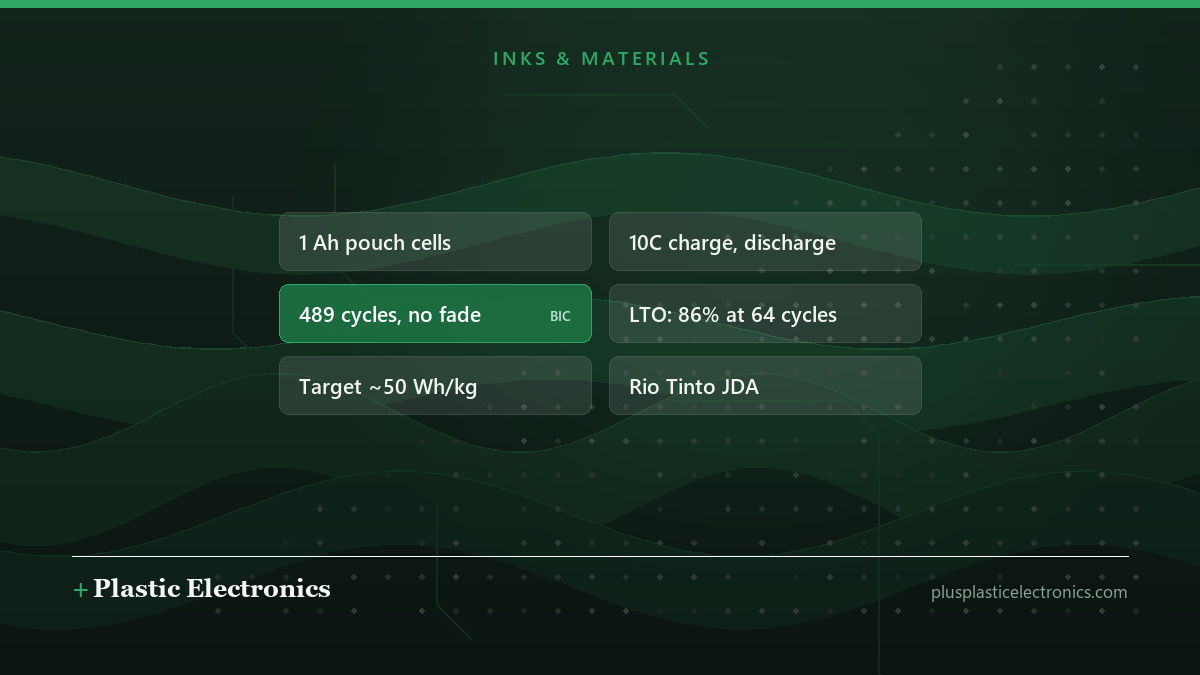
Graphene Manufacturing Group (GMG) says its graphene aluminium-ion cells have completed 489 charge-discharge cycles with no measurable capacity fade, each cycle taking six minutes. The data, current as of 4 September, were collected by the Battery Innovation Center (BIC) in Indiana. The 1 Ah pouch cells were built by BIC using materials developed and supplied by GMG’s Brisbane Battery Development Centre.
The result
The test ran a full 10C charge and 10C discharge regime. GMG reports internal resistance of about 5 milliohms and a temperature rise of 4°C above ambient during testing. Under the same profile, the company says, a lithium titanate (LTO) benchmark cell fell to 86% of its capacity within 64 cycles.
“Sustaining zero measurable capacity fade past 489 cycles under a full 10C charge… is a result that stands in stark contrast to the LTO benchmark cell,” said Bob Galyen, a GMG director and former chief technology officer of CATL. Chief executive Craig Nicol told Proactive Investors on 11 September: “We worked five years for this tech to get here.”
The caveats
Fast, durable cycling is only half of a battery. GMG describes the cells’ energy density as currently unoptimised, with a target of around 50 Wh/kg at a 10C charge rate. That target is modest by the standards of mainstream lithium-ion cells, which is why fast-cycling chemistries like this tend to be pitched at power-dense, high-cycle roles rather than long runtime.
The comparison with LTO also deserves care. The benchmark result is reported by GMG, the test is continuing, and 489 cycles is a snapshot rather than an end-of-life figure. We have not seen BIC’s own test report.
It is also worth being clear about what a 10C test shows. A six-minute cycle stresses a cell’s power handling and heat management. It says little about calendar life, behaviour at low temperatures or performance at the gentler rates most devices actually use.
GMG told Proactive Investors that its next steps include optimising the cells with a reduced electrolyte formulation, testing different charging algorithms and sending out customer samples shortly. It is developing the technology under a joint development agreement with Rio Tinto.
Why it matters for materials suppliers
For the printed and flexible electronics supply chain, GMG is as much a graphene producer as a battery developer. Nicol told Proactive Investors that its Gen 2.0 graphene production is operational, and that the company plans a “factory of factories” model: 20-tonne graphene production facilities built in Brisbane that could be relocated to Canada or the United States. GMG has also set up sales operations in India, South Korea, Japan and Singapore as well as Australia.
What we’re watching
- The cycle count at which the cells first show measurable fade, and BIC’s own reporting of it.
- Progress towards the 50 Wh/kg target, which will decide where these cells can compete.
- Results from customer samples and any first commercial agreement.